
TL;DR
- The ICD 10 code for CHF is I50.9, Heart failure, unspecified, when the provider documents no type or acuity.
- Specific codes exist for systolic (I50.2x, HFrEF), diastolic (I50.3x, HFpEF), and combined (I50.4x) heart failure.
- The fifth digit tells you the acuity: 1 acute, 2 chronic, 3 acute on chronic. For example, I50.23 means acute on chronic systolic heart failure.
- History of CHF codes to Z86.79 only when the condition has fully resolved. Active chronic heart failure still codes to I50.x.
- When CHF and hypertension appear together, sequence I11.0 first, then the I50.x code. Category I50 has no changes for FY2027.
Congestive heart failure shows up on cardiology, primary care, and hospital claims every single day. Yet payers reject thousands of these claims each year for one simple reason: the coder defaulted to the unspecified code when the chart supported something better.
Every I50.9 you submit without checking the echo report leaves money on the table and invites a clinical validation denial. The good news is that CHF coding follows a clear two-question pattern. This guide walks you through every ICD 10 code for CHF, the FY2027 rules, and the documentation you need to pick the right one.
What Is the ICD 10 Code for CHF?
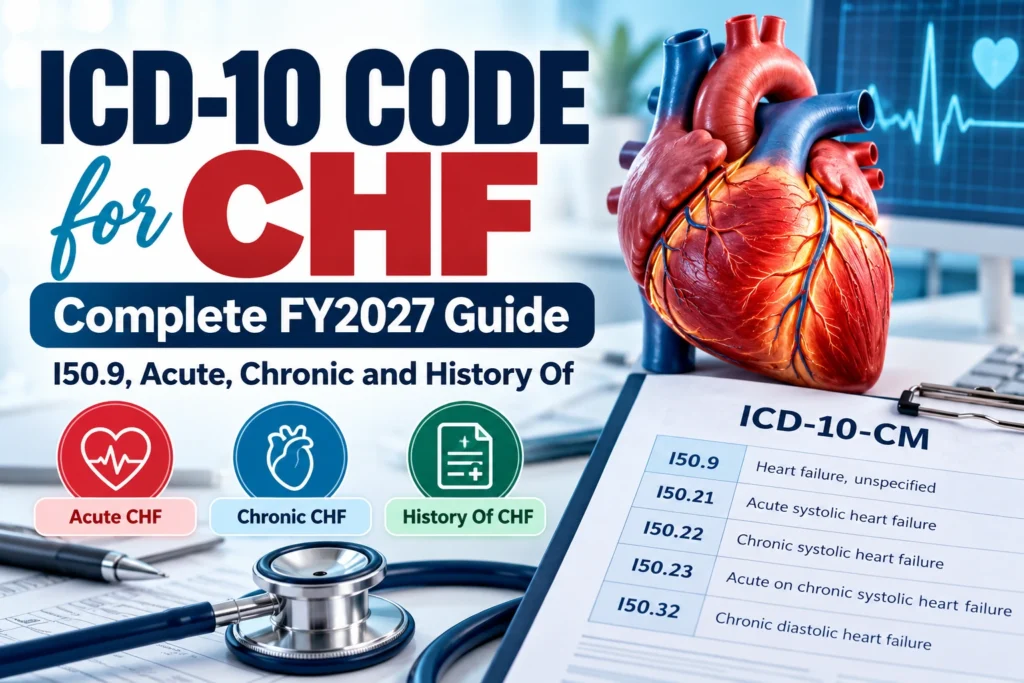
The ICD 10 code for CHF is I50.9, Heart failure, unspecified. You use it when the provider writes “CHF” or “congestive heart failure” and gives no further detail about type or acuity.
ICD-10-CM does not contain a standalone code called “congestive heart failure.” Instead, the Alphabetic Index sends “congestive heart failure NOS” directly to I50.9. That design choice pushes coders toward the more specific codes inside category I50 whenever the documentation allows.
Category I50 sits in Chapter IX, Diseases of the Circulatory System (I00 to I99). For FY2027 it contains 29 codes, and 23 of them are billable, which you can confirm in the CDC/NCHS ICD-10-CM browser. Before you assign any of them, ask two questions: What type of heart failure did the provider document? What is its acuity?
Complete List of CHF ICD-10 Codes (Category I50, FY2027)
The table below lists every code in category I50 that is valid for dates of service from October 1, 2026 through September 30, 2027. The CC/MCC column shows how each code affects inpatient MS-DRG severity.
| Code | Description | Billable | CC/MCC |
|---|---|---|---|
| I50.1 | Left ventricular failure, unspecified | Yes | CC |
| I50.20 | Unspecified systolic (congestive) heart failure | Yes | CC |
| I50.21 | Acute systolic (congestive) heart failure | Yes | MCC |
| I50.22 | Chronic systolic (congestive) heart failure | Yes | CC |
| I50.23 | Acute on chronic systolic (congestive) heart failure | Yes | MCC |
| I50.30 | Unspecified diastolic (congestive) heart failure | Yes | CC |
| I50.31 | Acute diastolic (congestive) heart failure | Yes | MCC |
| I50.32 | Chronic diastolic (congestive) heart failure | Yes | CC |
| I50.33 | Acute on chronic diastolic (congestive) heart failure | Yes | MCC |
| I50.40 | Unspecified combined systolic and diastolic heart failure | Yes | CC |
| I50.41 | Acute combined systolic and diastolic heart failure | Yes | MCC |
| I50.42 | Chronic combined systolic and diastolic heart failure | Yes | CC |
| I50.43 | Acute on chronic combined systolic and diastolic heart failure | Yes | MCC |
| I50.810 | Right heart failure, unspecified | Yes | None |
| I50.811 | Acute right heart failure | Yes | MCC |
| I50.812 | Chronic right heart failure | Yes | CC |
| I50.813 | Acute on chronic right heart failure | Yes | MCC |
| I50.814 | Right heart failure due to left heart failure | Yes | CC |
| I50.82 | Biventricular heart failure | Yes | CC |
| I50.83 | High output heart failure | Yes | CC |
| I50.84 | End stage heart failure | Yes | CC |
| I50.89 | Other heart failure | Yes | CC |
| I50.9 | Heart failure, unspecified | Yes | None |
Notice the pattern in the fifth digit. A zero means the acuity is unspecified, a one means acute, a two means chronic, and a three means acute on chronic. Once you learn that pattern, you can build most CHF codes from memory.
Category I50.2 includes heart failure with reduced ejection fraction (HFrEF). Category I50.3 includes heart failure with preserved ejection fraction (HFpEF). Finally, remember the “code also” instruction: when the provider documents end stage heart failure, add I50.84 alongside the type-specific code.
ICD 10 Code for CHF Unspecified (I50.9)
The ICD 10 code for CHF unspecified is I50.9. It is a valid, billable code for FY2027, and sometimes it is the honest choice. For instance, a patient arrives in the emergency department with new edema and dyspnea, the provider writes “CHF, workup pending,” and no echo exists yet. I50.9 fits that encounter.
However, I50.9 becomes a coding error the moment the record supports a specific type. The most common culprit is the EHR problem list. It carries I50.9 forward from an old visit even though a later echocardiogram clearly documents reduced ejection fraction.
Payers know this pattern well. I50.9 carries no CC or MCC weight for inpatient claims, and it draws clinical validation reviews on risk-adjusted outpatient claims. Therefore, query the provider before you accept the unspecified code.
Acute CHF ICD-10 Codes
The ICD 10 codes for acute CHF are I50.21 (systolic), I50.31 (diastolic), and I50.41 (combined). Use these codes when the provider documents a new, sudden episode of heart failure with no prior chronic diagnosis.
Look for cues such as “acute,” “new onset,” or “acute decompensated heart failure” in a patient without a known history. All three acute codes group as MCCs, so they carry significant weight on inpatient claims.
Be careful with the word “acute” by itself. If the patient already has chronic heart failure and now presents with a flare, you need the acute on chronic code instead, which we cover below.
Chronic CHF ICD-10 Codes
The ICD 10 codes for chronic CHF are I50.22 (systolic), I50.32 (diastolic), and I50.42 (combined). These codes describe stable, compensated heart failure that the provider manages over time.
Documentation often includes phrases such as “stable on guideline-directed therapy,” “compensated,” or an NYHA class. Each chronic code counts as a CC on inpatient claims.
One important nuance comes from the AHA Coding Clinic. When a provider documents heart failure with improved or recovered ejection fraction, you assign I50.32, chronic diastolic heart failure, because the current ejection fraction now falls in the preserved range.
Acute on Chronic CHF ICD-10 Codes
The ICD 10 codes for acute on chronic CHF are I50.23 (systolic), I50.33 (diastolic), and I50.43 (combined). Use them when a patient with established chronic heart failure experiences a sudden worsening.
Providers rarely write “acute on chronic” in those exact words. Instead, you will see the following terms, and each one supports the acute on chronic code when the chronic diagnosis is already established:
| Provider wording | Correct code family |
|---|---|
| “CHF exacerbation” | I50.23 / I50.33 / I50.43 |
| “Decompensated chronic heart failure” | I50.23 / I50.33 / I50.43 |
| “Flare of known HFrEF” | I50.23 |
| “Acute decompensation of HFpEF” | I50.33 |
Many coders still believe I50.9 is the “exacerbation code.” It is not. An exacerbation implies both a chronic baseline and an acute change, and ICD-10-CM gives you a specific code for exactly that scenario. Moreover, all three acute on chronic codes qualify as MCCs, which makes them the single biggest severity lever in the entire category.
History of CHF ICD-10 Code: Z86.79 vs. I50.x
The ICD 10 code for history of CHF is Z86.79, Personal history of other diseases of the circulatory system, but only when the heart failure has truly resolved. In most charts, “history of CHF” actually describes an active, chronic condition that the provider still treats.
Clinicians use “history of” in two different ways. Sometimes it means the condition existed in the past and no longer requires treatment. More often it means the patient has lived with the condition for years and still takes medication for it.
Use this quick decision path:
- Is the patient on heart failure medication, under monitoring, or symptomatic? Assign the active I50.x code, usually chronic.
- Has the provider confirmed the heart failure resolved with no ongoing treatment? Assign Z86.79.
- Does the note leave it unclear? Query the provider.
A simple query works well: “The record states ‘history of CHF.’ Please clarify whether the heart failure is active and under current management, or resolved.” This matters for risk adjustment too, because Z86.79 maps to no HCC while chronic heart failure does.
HFrEF, HFpEF, HFmrEF and HFimpEF: Ejection Fraction to ICD-10 Code
Modern cardiology notes classify heart failure by ejection fraction rather than by the words “systolic” and “diastolic.” The 2022 AHA/ACC/HFSA heart failure guideline defines the four clinical categories, and the table below translates each one into its ICD-10-CM code family. The EF thresholds and Coding Clinic references are also summarized in this ACDIS Q&A on systolic versus diastolic heart failure.
| Clinical term | Ejection fraction | ICD-10-CM code family |
|---|---|---|
| HFrEF (reduced) | 40% or less | I50.2x |
| HFmrEF (mildly reduced) | 41% to 49% | I50.2x (AHA Coding Clinic, 3Q 2020) |
| HFpEF (preserved) | 50% or higher | I50.3x |
| HFimpEF / HFrecEF (improved or recovered) | Previously 40% or less, now above 40% | I50.32 (AHA Coding Clinic, 3Q 2020) |
One rule governs this entire table: the ejection fraction number alone never assigns a code. A 35% EF buried in an echo report does not become I50.22 until the provider documents “systolic heart failure,” “HFrEF,” or an equivalent diagnosis. When the number and the diagnosis do not match, query.
Coding CHF With Hypertension and CKD (I11.0, I13.0, I13.2)
The ICD-10-CM Official Guidelines presume a causal relationship between hypertension and heart failure. Consequently, when both conditions appear in the same record, you assign the combination code first and the heart failure type second, unless the provider explicitly states the two are unrelated.
For hypertension with heart failure, sequence I11.0, Hypertensive heart disease with heart failure, followed by the specific I50.x code. The same presumption applies whether the note says “hypertension” or “HTN,” so do not wait for the provider to write the word “hypertensive.”
When chronic kidney disease joins the picture, switch to category I13. Use I13.0 for heart failure with CKD stage 1 through 4 or unspecified, and I13.2 for heart failure with stage 5 CKD or ESRD. Then add the I50.x code and the N18.x code for the CKD stage.
Here is a worked example. The provider documents “acute on chronic HFrEF, hypertension, CKD stage 3b.” You report I13.0, then I50.23, then N18.32. Always confirm the CKD stage in the note, because the N18 code must match it exactly.
Documentation Checklist and Common CHF Coding Errors
Accurate CHF coding depends entirely on what the provider writes. Before you finalize a code, confirm the chart addresses each of these six points.
- Type: systolic, diastolic, combined, or right-sided
- Acuity: acute, chronic, or acute on chronic
- Ejection fraction with the date of the most recent echo
- Hypertension or CKD linkage, or a statement that they are unrelated
- End stage status, if applicable
- Clarification of any “history of” language
Even experienced coders fall into the same five traps. First, they default to I50.9 when an echo on file supports a specific type. Second, they report a systolic code and a diastolic code together, which violates the Excludes1 note. The correct choice is a combined I50.4x code.
Third, they assign E87.70 for fluid overload when the fluid overload stems from heart failure. That code applies only when the overload is unrelated to CHF. Fourth, they code hypertension and heart failure as two separate conditions instead of using I11.0. Finally, they forget to add I50.84 when the provider documents end stage heart failure.
Specificity errors sit at the top of nearly every cardiology denial report. When a payer rejects a claim for an unspecified code, pull the echo report, confirm the documented type and acuity, and resubmit with the corrected I50.x code and a short clinical summary.
What Changed for CHF Codes in FY2027?
Category I50 received no additions, deletions, or revisions in the FY2027 ICD-10-CM update that took effect on October 1, 2026. Every code in the table above remains valid through September 30, 2027, and you can download the official code files from the CMS ICD-10 page.
That said, FY2027 did add new specificity elsewhere in Chapter IX, including the cardiac arrhythmia codes. Cardiology coders should review the full CMS change list, confirm the date of service for each claim, and watch for the April 2027 mid-year update.
Conclusion
Treat I50.9 as a fallback, never as a default. Ask two questions on every encounter, what type and what acuity, and the correct ICD 10 code for CHF nearly always reveals itself. Add the hypertension and CKD combination rules, clear up any “history of” language, and your cardiology claims will pay faster with fewer denials.
Bookmark the code table above, verify every code against the current CMS files on each October 1 and April 1, and keep building your cardiology coding knowledge with the related guides below.
Related Guides and Resources
- Shortness of Breath ICD-10 Code (R06.02): Coding Guide – a common presenting symptom of heart failure and a frequent companion code on CHF claims
- Hypothyroidism ICD-10 Code (E03.9): Coding Guide – a comorbidity that often appears alongside cardiac diagnoses
- Left Leg Pain ICD-10 Code (M79.605): Coding Guide – symptom coding rules for lower extremity complaints
- CPT Code 99205: New Patient Office Visit, High Complexity – the E/M level most often paired with a new CHF diagnosis
Frequently Asked Questions
What is the ICD 10 code for CHF?
The ICD 10 code for CHF is I50.9, Heart failure, unspecified. When the provider documents the type and acuity, you use a more specific code such as I50.22 or I50.33.
Is I50.9 a billable code in 2027?
Yes. I50.9 is billable for dates of service through September 30, 2027. However, it carries no CC or MCC weight and often triggers specificity reviews.
What is the ICD 10 code for CHF exacerbation?
A CHF exacerbation codes to the acute on chronic family: I50.23 for systolic, I50.33 for diastolic, and I50.43 for combined heart failure.
What is the ICD 10 code for history of CHF?
Use Z86.79 only when the heart failure has resolved. If the patient still takes medication or receives monitoring, code the active chronic heart failure with I50.x.
Can you code CHF and hypertension separately?
No. The Official Guidelines presume a link, so you report I11.0 first and the I50.x code second, unless the provider documents that the conditions are unrelated.
What is the ICD 10 code for HFrEF and HFpEF?
HFrEF codes to the I50.2x family, and HFpEF codes to the I50.3x family. The fifth digit depends on the documented acuity.
Did the ICD 10 code for CHF change for FY2027?
No. Category I50 has no changes for FY2027.