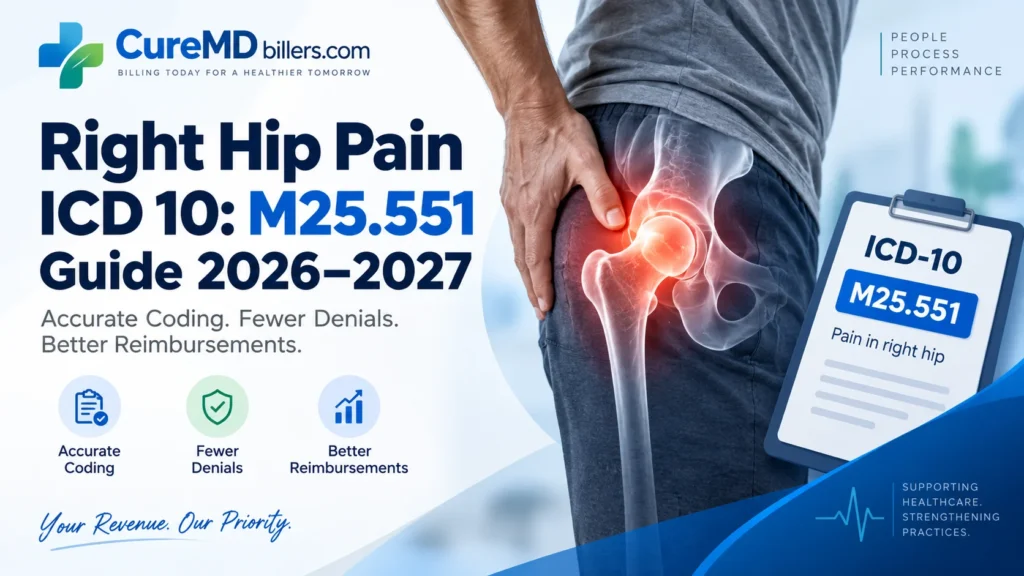

The right hip pain ICD 10 code is M25.551, but choosing the correct code involves more than finding a number. Confusing laterality, overlooking a confirmed diagnosis, or adding unsupported pain codes can create inaccurate claims and unnecessary corrections.
This guide explains right, left, bilateral and unspecified hip pain coding, with practical examples to help you match U.S. ICD-10-CM codes to the documentation.
TL;DR: Right Hip Pain ICD 10 at a Glance
- M25.551 identifies pain in the right hip.
- M25.552 identifies pain in the left hip.
- M25.559 identifies pain in an unspecified hip.
- Bilateral hip pain requires both side-specific symptom codes when appropriate.
- An unknown cause does not make the affected side unspecified.
- A confirmed diagnosis, documented injury or pain-management encounter may change code selection or sequencing.
- Billable status does not guarantee insurance coverage or payment.
What Is the ICD-10-CM Code for Right Hip Pain?
M25.551 is the ICD-10-CM code for “Pain in right hip.” It identifies the symptom’s location and side without identifying its cause.
The code belongs to Chapter 13, Diseases of the musculoskeletal system and connective tissue. It sits within the M25.55 subcategory for hip pain.
| Coding detail | Information |
|---|---|
| Complete code | M25.551 |
| Official description | Pain in right hip |
| Laterality | Right |
| Parent subcategory | M25.55, Pain in hip |
| Billable code | Yes |
| Seventh-character extension | Not required |
M25.55 is a parent subcategory, so select the appropriate complete code for reporting. M25.551 already contains the required characters; do not append an injury-style A, D or S extension.
Right, Left, Bilateral and Unspecified Hip Pain Codes
Laterality means the affected side of the body. Match the code to the documented hip rather than choosing whichever option appears first in your billing software.
| Documented symptom | ICD-10-CM code | Description |
|---|---|---|
| Right hip pain | M25.551 | Pain in right hip |
| Left hip pain | M25.552 | Pain in left hip |
| Bilateral hip pain | M25.551 and M25.552 | Report each affected hip |
| Hip pain, side unspecified | M25.559 | Pain in unspecified hip |
The CMS FY2026 code descriptions identify the right, left and unspecified hip pain codes.
What Is the ICD-10 Code for Left Hip Pain?
M25.552 identifies pain in the left hip. Like the right-sided code, it describes a symptom rather than establishing arthritis, bursitis or another underlying condition.
How Do You Code Bilateral Hip Pain?
When symptom coding appropriately represents pain in both hips, report M25.551 and M25.552. The M25.55 family does not provide one bilateral hip pain code.
However, assess each side separately when the documentation identifies different conditions. A confirmed disorder in one hip may require a different approach from unexplained pain in the other.
Does an Unknown Cause Mean “Unspecified Hip Pain”?
No. An unknown cause and an unspecified side describe different information gaps.
For example, “right hip pain, cause undetermined” identifies the side. M25.551 retains that documented detail even though the provider has not established why the hip hurts.
In contrast, “hip pain” without further laterality information may support M25.559. Review the available record and seek clarification when appropriate before selecting an unspecified code.
The same distinction applies to left hip pain. An unknown cause does not justify replacing M25.552 with M25.559 when the record identifies the left hip.
When Should You Use M25.551?
M25.551 may represent an outpatient encounter involving documented right hip pain when the provider has not established a more definitive diagnosis. It can describe the reason for evaluation while the diagnostic workup continues.
Start with the assessment, then review the encounter’s purpose and relevant classification instructions. Do not assume that every mention of hip discomfort warrants a separate diagnosis code.
For outpatient reporting, do not treat probable, suspected or rule-out conditions as confirmed diagnoses. Instead, report the symptoms, findings or reason for the encounter to the highest degree of certainty available.
Imaging is not a universal prerequisite for using M25.551. Likewise, the code does not automatically become inappropriate simply because the patient returns for another visit.
When a Confirmed Condition or Injury Changes the Code
Hip Pain Versus a Confirmed Hip Disorder
A provider may establish osteoarthritis, trochanteric bursitis or another condition after evaluating hip pain. At that point, review the code for the documented diagnosis and determine whether separate symptom reporting remains appropriate.
Do not automatically retain M25.551 beside every confirmed hip diagnosis. Pain routinely associated with a condition generally does not require separate reporting unless classification instructions direct otherwise.
| Documentation identifies | Next coding step |
|---|---|
| Hip osteoarthritis | Verify the documented type and laterality |
| Trochanteric bursitis | Review the applicable bursitis code |
| Hip strain | Check the injured structure and encounter requirements |
| Referred pain | Review the provider’s established diagnosis and documented location |
These conditions are not interchangeable alternatives. Symptoms, tenderness or an imaging finding alone should not prompt the coder to invent a diagnosis.
Pain After a Fall Versus a Diagnosed Injury
A fall may explain why the evaluation began, but it does not independently establish a fracture, strain or sprain. Review what the provider actually diagnosed.
When the provider documents an injury, follow the relevant injury category and its requirements. Unlike M25.551, many injury codes require an encounter character.
Acute and Chronic Right Hip Pain ICD-10 Coding
Does Acute Hip Pain Have a Different Code?
M25.551 does not distinguish acute from chronic pain. Recent onset therefore does not automatically require another code.
First, check whether the provider documented a specific condition or injury. Then determine whether additional pain information affects reporting.
When Can G89.29 Add Chronic-Pain Information?
G89.29 identifies other chronic pain and may add relevant information when documentation supports it. Do not add it automatically because symptoms have lasted several months.
ICD-10-CM does not establish a universal duration that makes pain chronic. Provider documentation guides that classification.
Sequencing also depends on the encounter’s purpose. For pain-control or pain-management encounters, the applicable G89 code may come first; other encounters require a different sequencing assessment.
The Official ICD-10-CM Guidelines for Coding and Reporting explain these pain-code rules. They also distinguish chronic pain from chronic pain syndrome, which requires specific documentation before assigning G89.4.
Documentation and Billing Checklist for Right Hip Pain
Before reporting a hip pain diagnosis, review the information that supports the coding decision:
- The documented location and affected side.
- Whether symptoms involve one hip or both.
- Any confirmed underlying diagnosis.
- A documented injury and relevant encounter details.
- Chronic-pain documentation when applicable.
- The purpose of the visit.
- Applicable code instructions and reporting requirements.
Pain severity, functional limitations and examination findings can also help explain the care provided. However, a detailed description does not replace a clear assessment.
Separate diagnosis selection from service reporting. ICD-10-CM describes diagnoses and reasons for care, while CPT identifies services and procedures.
Consequently, M25.551 does not determine an office-visit level or establish coverage for therapy or imaging. Check the service documentation, medical necessity and applicable payer requirements separately.
Right Hip Pain Coding Examples
The following examples illustrate coding decisions. Each assumes that the available documentation supports the stated circumstances.
Example 1: Right Hip Pain Without a Confirmed Cause
The provider documents right hip pain during an outpatient evaluation but does not establish a specific disorder. Further evaluation remains necessary.
M25.551 captures the documented symptom and side. The unresolved cause does not justify switching to an unspecified-hip code.
Example 2: Both Hips Hurt, With Greater Pain on the Right
The provider assesses pain in both hips and documents no definitive underlying condition. The right hip causes more discomfort.
Report M25.551 and M25.552 when both symptoms qualify for reporting. Greater severity on the right does not remove the documented left-sided pain.
Example 3: The Record Does Not Identify the Side
The assessment states “hip pain,” and the available documentation does not clarify laterality. The coder cannot resolve the missing detail through the appropriate clarification process.
M25.559 may represent the unspecified hip. Do not guess the side merely to avoid an unspecified code.
Example 4: The Provider Confirms a Hip Condition
The provider attributes the patient’s right hip pain to a confirmed hip disorder. The encounter addresses that condition.
Review the appropriate diagnosis code and its instructions. Do not automatically add M25.551 solely to restate pain that routinely accompanies the diagnosed condition.
Example 5: The Encounter Focuses on Chronic-Pain Management
The provider documents chronic right hip pain without a confirmed cause, and the encounter specifically focuses on pain management. The record supports other chronic pain rather than chronic pain syndrome.
G89.29 may take the first-listed position, with M25.551 identifying the site. Confirm the encounter purpose before applying that sequence.
Which ICD-10-CM Release Should You Use?
Use the code set applicable to the encounter’s reporting period. As of September 15, 2026, the April 1, 2026 release applies through September 30, 2026.
The FY2027 release applies beginning October 1, 2026. Its availability does not make it applicable to earlier encounters.
The CDC ICD-10-CM files page provides release dates and official downloads. Check applicable guidelines, addenda and errata alongside the code descriptions.
Conclusion
The right hip pain ICD 10 code is M25.551. Accurate coding starts with confirming the affected side, reviewing the provider’s diagnosis and understanding the encounter’s purpose.
Before submitting a claim, check whether a confirmed condition or documented chronic pain changes code selection or sequencing. Finally, verify the applicable ICD-10-CM release and payer requirements, because a billable diagnosis code alone does not guarantee payment.
Related Guides and Resources
Continue exploring related coding topics with these CureMD Billers guides:
- Right Shoulder Pain ICD-10 Guide: Compare another joint-pain code family.
- Left Knee Pain ICD-10 Guide: Review laterality and symptom-code selection.
- Physical Therapy CPT Codes: Explore therapy-service reporting considerations.
- 99213 CPT Code Guide: Review established-patient office-visit requirements.
Use the official CMS and CDC resources linked above to verify coding decisions. This guide provides educational information; individual encounters require review of the complete documentation and applicable instructions.
Frequently Asked Questions
Is M25.551 a Billable Diagnosis Code?
Yes. M25.551 is a complete, billable ICD-10-CM code for right hip pain. However, coverage and payment also depend on the service, documentation, medical necessity and payer requirements.
Does M25.551 Require a Seventh Character?
No. M25.551 is complete as written. Do not add A, D or S simply because the visit involves an initial evaluation, continued care or persistent symptoms.
Is There One Code for Bilateral Hip Pain?
No single bilateral code exists within the M25.55 hip-pain family. Report M25.551 and M25.552 when the documentation supports bilateral symptoms and symptom coding appropriately represents the encounter.
Which Code Applies When the Right Hip Hurts but the Cause Is Unknown?
M25.551 identifies documented right hip pain. An unknown cause does not make the hip unspecified because the record already identifies the affected side.
Can M25.551 Apply During Physical Therapy?
Yes, when the documented condition and applicable reporting rules support it. Nevertheless, the diagnosis code alone does not establish the medical necessity or coverage of a particular therapy service.
Does Right Hip Pain Determine the Office-Visit CPT Code?
No. Select the office-visit code using the applicable E/M requirements and documented work. The same hip-pain diagnosis can accompany different service levels under different circumstances.