
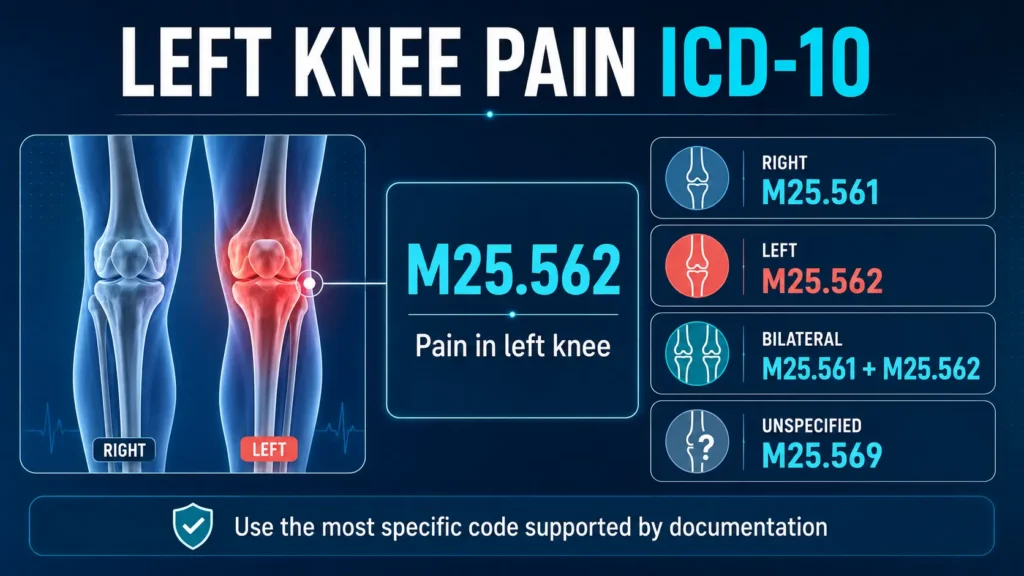

Knee pain coding may look straightforward, but choosing the wrong laterality, reporting an unspecified code, or overlooking a confirmed condition can weaken a claim. Chronic pain and injuries create additional coding questions. Fortunately, clear documentation makes the decision easier. This guide explains the left knee pain ICD 10 code, related knee pain codes, documentation requirements, coding examples, and 2026–2027 guidance.
Table of Contents
ToggleTLDR: Left Knee Pain ICD 10 at a Glance
- M25.562 is the ICD-10-CM code for pain in the left knee.
- M25.561 represents pain in the right knee.
- M25.569 represents pain in an unspecified knee.
- M25.562 is a billable and laterality-specific diagnosis code.
- Bilateral knee pain generally requires both M25.561 and M25.562.
- Do not use M25.569 when the record identifies the affected knee.
- A confirmed condition, such as osteoarthritis or a ligament injury, may require a more specific code.
- G89.29 may provide additional information about chronic pain, but it is not automatically required.
- Use the ICD-10-CM code set that applies to the encounter’s date of service.
What Is the ICD-10 Code for Left Knee Pain?
The ICD-10-CM code for left knee pain is:
M25.562: Pain in left knee
M25.562 appears in Chapter 13, Diseases of the musculoskeletal system and connective tissue. It belongs to the M25 category for other joint disorders, not elsewhere classified.
M25.562 is a complete and billable code. It identifies the location and laterality of the patient’s pain, but it does not identify its cause.
Providers may document left knee pain when they have not yet established an underlying diagnosis. For example, the patient may report pain, stiffness, or reduced movement while further evaluation remains necessary.
M25.562 quick facts
| Coding detail | Information |
|---|---|
| ICD-10-CM code | M25.562 |
| Description | Pain in left knee |
| Billable and specific | Yes |
| Laterality | Left |
| Code type | Symptom diagnosis |
| Bilateral code available | No |
| Applicable chapter | Musculoskeletal system and connective tissue |
The CDC ICD-10-CM Browser allows users to search the Alphabetic Index and Tabular List. Coders should consult both resources because a search result alone may not show every relevant convention or instruction.
Knee Pain ICD-10 Codes by Laterality
ICD-10-CM distinguishes between pain in the right knee, left knee, and an unspecified knee. Therefore, the medical record should identify the affected side whenever possible.
| Documented condition | ICD-10-CM code | Description |
|---|---|---|
| Right knee pain | M25.561 | Pain in right knee |
| Left knee pain | M25.562 | Pain in left knee |
| Unspecified knee pain | M25.569 | Pain in unspecified knee |
| Bilateral knee pain | M25.561 and M25.562 | Report each affected side |
Use M25.562 when the record identifies the left knee. Do not report M25.569 simply because it appears first in a search result or billing system.
Coders also should not infer laterality from a previous visit, imaging order, or procedure schedule. The documentation for the current encounter should support the selected code.
When Should You Use M25.562?
M25.562 may be appropriate when the provider evaluates or treats pain in the left knee but has not established a more definitive diagnosis.
Documentation that may support M25.562 includes:
- Left knee pain with no confirmed cause
- Persistent pain localized to the left knee
- Left knee discomfort after increased activity
- Chronic left knee pain without a confirmed structural condition
- Left knee pain under further evaluation
The record should show that the provider assessed or addressed the complaint. A diagnosis copied into the chart without a connection to the encounter may not establish medical necessity for the service.
In addition, M25.562 does not describe the severity, duration, or cause of the pain. Providers should document these details when they affect evaluation, treatment, or code selection.
When M25.562 May Not Be the Best Code
M25.562 describes a symptom. When the provider confirms the underlying cause, a condition-specific code may better represent the diagnosis.
Examples include:
| Confirmed condition | Potential ICD-10-CM family |
|---|---|
| Knee osteoarthritis | M17.- |
| Patellofemoral disorder | M22.- |
| Meniscus disorder | M23.- or an applicable injury code |
| Knee effusion | M25.46- |
| Knee instability | M23.- or M25.36- |
| Ligament sprain | S83.- |
| Fracture involving the knee region | Applicable S82.- code |
| Postprocedural pain | Applicable G89 or complication code |
These code families are examples, not automatic replacements. Coders must select the code that matches the provider’s documented diagnosis, laterality, cause, and encounter details.
For instance, a coder should not assign a meniscus tear because the patient reports pain after twisting the knee. The provider must establish the diagnosis.
Can M25.562 be reported with knee osteoarthritis?
Pain commonly occurs with knee osteoarthritis. Therefore, coders should not automatically report M25.562 in addition to a confirmed osteoarthritis code.
A separate pain code may be appropriate when the pain receives independent evaluation, is not routinely associated with the diagnosed condition, or applicable guidance otherwise permits separate reporting. The complete record and care setting determine the final decision.
The FY2026 ICD-10-CM Official Guidelines for Coding and Reporting explain that signs and symptoms routinely associated with a definitive diagnosis generally should not receive additional codes. However, coders may report symptoms that are not routinely associated with the condition when the documentation supports them.
Bilateral Knee Pain ICD-10 Coding
ICD-10-CM does not provide one M25.56 code for bilateral knee pain. When the provider documents pain in both knees without a more definitive condition, report:
- M25.561 for pain in the right knee
- M25.562 for pain in the left knee
Do not use M25.569 to represent bilateral knee pain. M25.569 means the documentation does not identify which knee is affected.
For example, consider the documentation: “Patient presents with pain in both knees. The cause remains under evaluation.” The coding direction would generally include M25.561 and M25.562.
Both diagnoses may appear on the same claim when they relate to the reported services. Billing teams should connect each service line to the appropriate diagnosis according to the claim format and payer requirements.
Chronic Left Knee Pain ICD 10 Coding
M25.562 identifies the anatomical location of left knee pain. If the provider documents chronic pain, G89.29, Other chronic pain, may provide additional information in certain circumstances.
However, coders should not automatically add G89.29 every time a record includes the word “chronic.” The reason for the encounter, underlying diagnosis, and provider documentation determine whether an additional G89 code is appropriate.
When a patient receives care primarily for pain control or pain management, the applicable G89 code may be sequenced before the site-specific pain code. When the encounter focuses on another condition or treatment purpose, sequencing may differ.
Chronic pain versus chronic pain syndrome
Chronic pain syndrome is not another name for persistent pain. It represents a distinct condition with important psychosocial features.
Report G89.4, Chronic pain syndrome, only when the provider specifically documents that diagnosis. Do not assign it based only on the duration or severity of knee pain.
| Documentation | Coding consideration |
|---|---|
| Left knee pain | M25.562 |
| Chronic left knee pain | M25.562; evaluate whether G89.29 applies |
| Encounter primarily for pain management | Review G89 sequencing guidance |
| Chronic pain syndrome | Requires explicit provider documentation |
Acute Left Knee Pain and Injuries
Acute left knee pain does not automatically indicate an injury. A patient may develop sudden pain without a diagnosed sprain, fracture, or tear.
Likewise, a fall, twist, or impact describes how the complaint began, but it does not establish a specific injury. Coders should not diagnose a ligament sprain or meniscus tear from the mechanism alone.
When the provider confirms an injury, select the applicable injury code. Many injury codes require details such as:
- Affected structure
- Left or right side
- Type of injury
- Displacement or other clinical characteristics
- Initial, subsequent, or sequela encounter status
For example, “acute left knee pain after exercise with no confirmed injury” differs from “sprain of a ligament of the left knee, initial encounter.” The second statement supports a specific injury code.
Documentation Requirements for Left Knee Pain
Clear documentation supports accurate code selection and creates a defensible connection between the diagnosis and service.
The record should identify:
- The affected anatomical site
- Left, right, or bilateral involvement
- Acute or chronic status when clinically relevant
- A known cause or confirmed diagnosis
- Injury details when applicable
- Symptoms evaluated during the encounter
- Relevant examination or assessment findings
- Treatment and follow-up plan
- The reason for the encounter
- Any relationship to surgery or another condition
If laterality or another clinically significant detail remains unclear, the coder may need to query the provider through the organization’s compliant query process. Providers should document the actual clinical circumstances rather than adding details solely to obtain payment.
Left Knee Pain Coding Examples
The following examples illustrate general coding direction. Final code selection requires review of the complete medical record.
| Documentation | Coding direction | Explanation |
|---|---|---|
| Left knee pain with no established cause | M25.562 | The site and laterality are documented |
| Right knee pain | M25.561 | The record supports the right-side code |
| Pain in both knees | M25.561 and M25.562 | Report each affected side |
| Knee pain with no side documented | M25.569 | The record lacks laterality |
| Chronic left knee pain | M25.562; assess G89.29 | Additional chronic-pain coding depends on the encounter |
| Unilateral primary osteoarthritis, left knee | M17.12 | The provider established a specific condition |
| Confirmed left knee ligament sprain | Applicable S83.- code | Use the documented injury details |
| Suspected meniscus tear during an outpatient visit | Code supported symptoms or findings | Do not report an uncertain outpatient diagnosis as confirmed |
In outpatient settings, coders do not report diagnoses documented as probable, suspected, questionable, rule out, or similar uncertain terms as though they were confirmed. Instead, they code the highest degree of certainty known for the encounter, such as documented symptoms and findings.
Common Knee Pain Coding Errors
Avoid these common problems:
- Reporting M25.569 when the documentation identifies the left knee
- Using M25.569 for bilateral knee pain
- Reporting M25.56 instead of the complete billable code
- Assigning M25.5691 or M25.5692, which are not valid ICD-10-CM codes
- Automatically adding G89.29 for every chronic complaint
- Confusing chronic pain with chronic pain syndrome
- Diagnosing an injury from a reported fall or twist
- Reporting knee pain redundantly with a confirmed condition
- Using a code set that does not match the date of service
- Assuming a valid code automatically guarantees reimbursement
A valid diagnosis code is only one part of an accurate claim. Documentation, medical necessity, the reported procedure, coverage requirements, and payer edits can also affect payment.
FY2026 and FY2027 ICD-10-CM Guidance
ICD-10-CM follows a fiscal-year update cycle. Therefore, coders should select the version that applies to the patient’s date of service.
The FY2026 files apply to relevant encounters through September 30, 2026. The FY2027 files apply to encounters from October 1, 2026, through September 30, 2027.
M25.562 remains the code for pain in the left knee in the released FY2027 code set. The CMS ICD-10 files page provides current code files, applicable dates, updates, and available official guidelines.
Before submitting a claim, check for updated guidelines, addenda, and errata. Payer policies may also change separately from the ICD-10-CM code set.
Final Knee Pain Coding Checklist
Before assigning a knee pain diagnosis:
- Confirm the affected knee.
- Identify unilateral or bilateral involvement.
- Check for a confirmed underlying diagnosis.
- Review documented injury details.
- Determine whether chronic-pain coding adds relevant information.
- Apply the correct sequencing guidance.
- Use the code set effective on the date of service.
- Verify documentation, medical necessity, and payer requirements.
Final Takeaway
M25.562 is the ICD-10-CM code for pain in the left knee. Use M25.561 for right knee pain and both codes for bilateral pain. Reserve M25.569 for records that do not identify laterality.
Before selecting M25.562, check for a confirmed disease or injury that requires more specific coding. Also review chronic-pain guidance, documentation, the care setting, the applicable code year, and payer requirements.
Related Guides and Resources
- Abdominal Pain ICD-10 Codes: Complete R10 Guide
- 99213 CPT Code: Billing and Reimbursement Guide
- 99214 CPT Code: Billing and Reimbursement Guide
- 99204 CPT Code: New-Patient Billing Guide
- Medical Coding Guides
This article provides general educational information. It does not replace the current ICD-10-CM code set, official coding guidelines, payer policies, or advice from a qualified coding professional.
Frequently Asked Questions
What is the ICD-10 code for left knee pain?
M25.562 is the ICD-10-CM code for pain in the left knee. It is appropriate when the record documents left knee pain without establishing a more specific diagnosis.
Is M25.562 a billable code?
Yes. M25.562 is sufficiently specific for claim reporting. However, billable status does not guarantee reimbursement because coverage also depends on documentation, medical necessity, the service performed, and payer policy.
What is the ICD-10 code for right knee pain?
M25.561 represents pain in the right knee. Use it when the documentation identifies the right side and does not support a more definitive condition.
What is the ICD-10 code for bilateral knee pain?
Report M25.561 for the right knee and M25.562 for the left knee. ICD-10-CM does not provide one M25.56 code for bilateral knee pain.
What is the code for unspecified knee pain?
M25.569 represents pain in an unspecified knee. Use it only when the medical record does not identify the affected side.
What is the ICD-10 code for chronic left knee pain?
M25.562 identifies the location of the pain. G89.29 may provide additional chronic-pain information when the documentation and reason for the encounter support its use.
Is M25.562 valid for 2027?
Yes. M25.562 remains listed as pain in the left knee in the released FY2027 ICD-10-CM files. FY2027 applies to qualifying encounters from October 1, 2026, through September 30, 2027.