
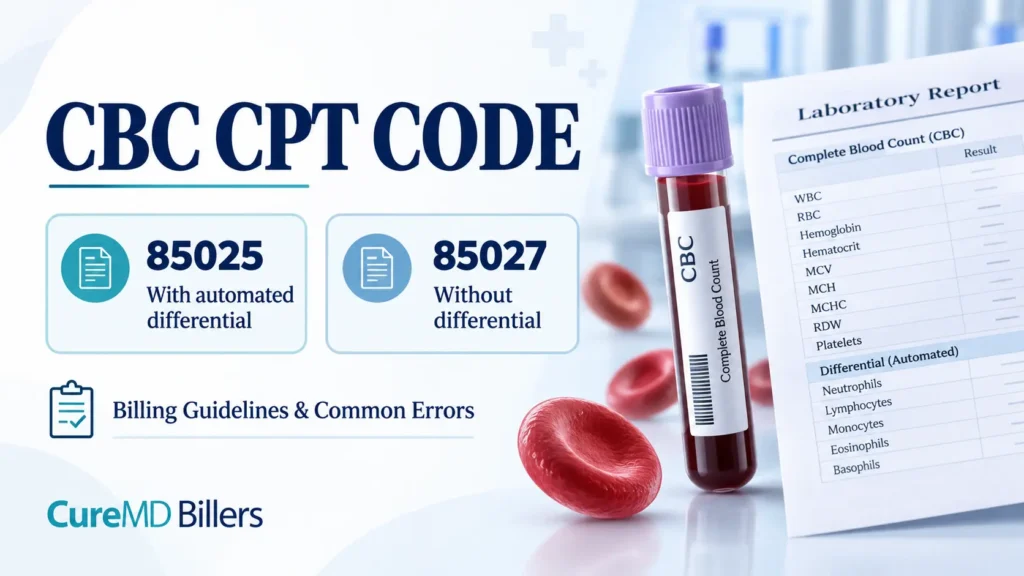

Choosing the wrong CBC CPT code can create an inaccurate claim, even when the laboratory performs a routine blood test. Confusion over differential methods, unclear orders, and overlapping charges can lead to payment delays and unnecessary corrections.
This guide explains how to distinguish CBC codes, match them to the documented service, and recognize billing situations that need closer review before you submit a claim.
TLDR: Which CBC CPT Code Should You Use?
- 85025: Automated complete blood count with an automated white blood cell differential.
- 85027: Automated complete blood count without a differential.
- Manual differential: Review the order, laboratory method, and reporting rules before selecting additional codes.
- Platelets: Both core CBC codes include a platelet count.
- Coverage: The procedure code identifies the service; medical necessity and payer requirements determine coverage.
Start with the order and compare it with the completed test. Resolve inconsistencies before choosing a code or adding a modifier.
What Is the CBC CPT Code?
The CBC CPT code is 85025 for an automated CBC with an automated WBC differential. Use 85027 for an automated CBC without differential when the order and completed service support that choice.
A complete blood count measures several blood components. However, the phrase “CBC” alone may not identify the differential method or clarify exactly what the practitioner requested.
| Test | CPT code | Main distinction |
|---|---|---|
| Automated CBC with automated differential | 85025 | Includes automated WBC differential |
| Automated CBC without differential | 85027 | Includes total WBC count without differential |
Laboratories may use terms such as “CBC with diff,” “CBC/DIFF,” or “CBC with auto diff.” Check the laboratory’s order definition whenever that wording leaves uncertainty.
CPT 85025 vs. 85027: What Is the Difference?
The automated white blood cell differential distinguishes 85025 from 85027. Both codes include the core blood counts and platelet measurement.
A total WBC count reports the combined number of white blood cells. In contrast, a differential identifies categories such as neutrophils, lymphocytes, monocytes, eosinophils, and basophils.
| Component | 85025 | 85027 |
|---|---|---|
| Red blood cell count | Included | Included |
| Total white blood cell count | Included | Included |
| Hemoglobin | Included | Included |
| Hematocrit | Included | Included |
| Platelet count | Included | Included |
| Automated WBC differential | Included | Not included |
Does “CBC With Platelets” Require Another Code?
Both core codes already include platelets. Therefore, the wording “CBC with differential/platelet” does not create a separate platelet service.
However, “CBC with platelets” alone does not confirm a differential. Review the request and laboratory report before choosing between 85025 and 85027.
CBC With Automated, Manual, or Reflex Differential
The differential method matters because automated and manual services describe different work. Also, additional laboratory activity does not always support an additional charge.
Automated Differential
An analyzer performs the automated differential as part of the service described by 85025. Confirm that the order and report support both the CBC and automated differential.
Ordered Manual Differential
Code 85007 describes blood smear examination with a manual WBC differential. Code 85009 identifies the buffy coat manual differential method, so the two codes are not interchangeable.
For Medicare, an ordered automated hemogram plus manual differential may support 85027 and 85007. The documentation must establish the requested services.
Reflex Verification and Physician Interpretation
A laboratory may examine a smear to complete or verify an automated CBC. That work does not automatically justify separate reporting of 85007 or 85008.
CMS also generally prohibits combining 85025 and 85007 because the combination duplicates differential payment. Review the circumstances against the CMS 2026 NCCI Policy Manual, Chapter X.
Physician smear interpretation represents another distinct activity. Before considering 85060, confirm that a physician performed the interpretation and produced the required written report.
How to Choose the Correct CBC Code
Follow a consistent review process instead of relying on a familiar abbreviation. The order, laboratory method, and completed report should describe a consistent service.
- Read the request. Identify the requested CBC and differential.
- Check the order definition. Confirm what the laboratory’s local test name includes.
- Review the report. Identify the method and completed components.
- Resolve discrepancies. Clarify unclear or conflicting information.
- Apply reporting rules. Check the requirements for the payer and date of service.
For example, a requisition may say “CBC” while the report includes differential results. Check the underlying order definition and seek clarification when necessary; the report alone does not establish what the practitioner authorized.
What Documentation Supports a CBC Claim?
Keep evidence of the order, clinical reason, and completed service. Clear documentation helps the billing team connect the claim to the care the practitioner requested.
CMS laboratory test order requirements recognize several acceptable documentation routes. An unsigned requisition does not automatically invalidate the order when the supporting record meets the applicable requirements.
Before submission, confirm that the record identifies:
- The specific test requested.
- The ordering practitioner.
- The documented reason for testing.
- The service the laboratory completed.
- Any clarification of the request.
- The reason for additional or repeat testing.
CPT, ICD-10-CM, and Laboratory Identifiers
These identifiers answer different questions. Keep them separate when transferring information to a claim.
| Identifier | Purpose |
|---|---|
| CPT | Identifies the procedure or service |
| ICD-10-CM | Identifies the documented diagnosis, symptom, or encounter circumstance |
| Laboratory order code | Identifies the test within a laboratory’s system |
| LOINC | Identifies a laboratory observation or measurement |
A local test number does not replace the CPT code. Similarly, a procedure code does not explain why the patient needed testing.
Does Medicare Cover CBC Testing?
Medicare coverage depends on more than selecting the correct code. The record must also support the clinical reason for testing.
Medicare NCD 190.15: Blood Counts addresses diagnostic evaluation, relevant conditions, and treatment monitoring. It also limits coverage for screening when the patient lacks symptoms or a relevant condition.
Use diagnosis information that accurately reflects the practitioner’s documentation. Do not choose a diagnosis simply because a coverage list includes it.
For example, a practitioner may request a CBC while evaluating documented anemia. Our anemia ICD-10 coding guide explains diagnosis distinctions, but an anemia code alone does not guarantee payment.
Finally, check the coverage material that applies to the date of service. Other payers may apply different requirements.
CBC Bundling Rules and Modifiers
For the same completed automated CBC-with-differential service, avoid adding overlapping component charges. Do not split that service into 85027 and 85004 merely to generate separate claim lines.
Also distinguish a clinically necessary repeat measurement from a rerun that verifies an initial result. Result verification and specimen or equipment problems do not establish grounds for modifier 91.
| Modifier | What to verify |
|---|---|
| 91 | Whether the repeat test meets clinical diagnostic laboratory reporting requirements |
| 90 | Whether reference-laboratory billing rules apply to the billing entity |
| QW | Whether the exact test system, code, and effective date qualify for waived-test reporting |
Do not add modifier 59 simply to bypass an edit. First determine whether the documented circumstances and applicable rules support a distinct service.
Common CBC Coding Errors and How to Avoid Them
Many errors begin when the order, report, and claim describe different services. A brief comparison can reveal the mismatch before submission.
| Common error | Better approach |
|---|---|
| Assuming every CBC includes a differential | Confirm the requested and completed test |
| Adding overlapping CBC components | Review comprehensive-code reporting |
| Charging separately for every reflex smear | Identify the purpose of the additional work |
| Confusing 85007 and 85009 | Match the code to the manual method |
| Treating technologist review as physician interpretation | Confirm who performed the work and what report exists |
| Choosing a diagnosis to obtain payment | Follow the documented clinical circumstances |
When you find an inconsistency, correct it at its source. Changing only the claim can leave the order or supporting record unresolved.
Likewise, investigate the stated reason for a denial before resubmitting. A missing order, duplicate charge, and coverage issue require different responses.
Practical CBC Coding Examples
These hypothetical examples illustrate the basic selection process. Actual claims still require the appropriate documentation and payer review.
CBC Without Differential
A practitioner requests an automated CBC without differential, and the laboratory completes that service. The documented work supports 85027.
CBC With Automated Differential
A practitioner requests a CBC with automated differential, and the laboratory reports both components. The documented work supports 85025.
An Ambiguous Request
The requisition says “CBC,” but another record specifies a differential. Review the order definition and resolve the discrepancy before coding.
CBC Reimbursement and Related Laboratory Services
Check the Medicare Clinical Laboratory Fee Schedule for the applicable period when researching Medicare payment. For other payers, consult the relevant contract and payment policy.
Keep the allowed amount, laboratory charge, and patient responsibility separate. One quoted price cannot represent all three.
A CBC and a metabolic panel assess different measurements. When an order includes CBC with CMP or BMP, review the completed services and applicable panel rules.
Similarly, a separate blood-collection code does not guarantee separate payment in every setting. For another example of laboratory-panel coding, see our CPT 80061 lipid panel guide.
Related Guides and Resources
Continue exploring these CureMD Billers resources:
- Anemia ICD-10 Codes: Review diagnosis distinctions when the practitioner documents anemia.
- CPT Code 80061: Lipid Panel Billing Guide: Explore another laboratory panel’s components and billing considerations.
- CPT Code Guides: Browse educational explanations of other procedure codes.
Use these guides to strengthen your understanding of coding and documentation. For individual claims, confirm the current official instructions and the payer’s applicable requirements.
Frequently Asked Questions About CBC CPT Codes
What Is the CPT Code for CBC With Differential?
Use 85025 for an automated CBC with an automated WBC differential when the documentation supports that service. If the laboratory performs a manual differential, review the appropriate codes and reporting conditions.
What Is the CPT Code for CBC Without Differential?
The code is 85027 for an automated CBC without differential. It still includes the total white blood cell count, red blood cell count, hemoglobin, hematocrit, and platelets.
Does CBC With Auto Diff Mean CBC With Automated Differential?
These phrases commonly describe the same automated service. However, confirm the laboratory’s order definition if local terminology creates uncertainty about the requested test or method.
Can You Report 85025 and 85027 for the Same CBC Service?
Do not report both for the same completed CBC-with-automated-differential service because they overlap. If the patient receives separate tests that day, review the circumstances and applicable reporting requirements.
Does an Abnormal CBC Result Automatically Justify Another Code?
An abnormal finding alone does not establish another billable procedure. Review any additional work, its purpose, the order, and the relevant reporting requirements before adding a code.
Does an Anemia Diagnosis Guarantee Medicare Payment for a CBC?
No. The documented circumstances and applicable coverage requirements still matter. Choose the diagnosis that reflects the record and confirm that the claim meets the relevant conditions.