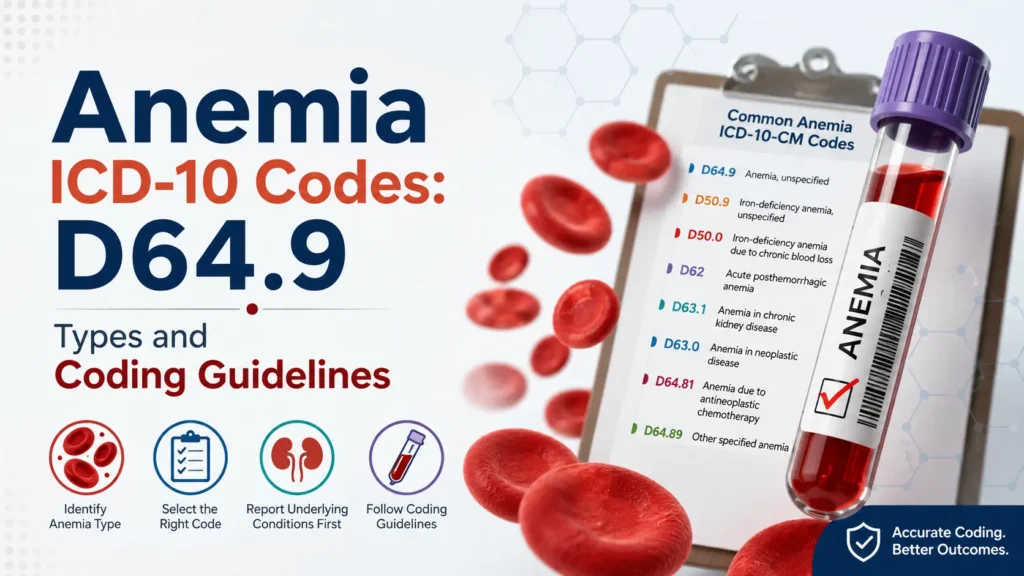

Choosing an anemia ICD-10 code may appear simple, but one unspecified diagnosis does not fit every patient. Iron deficiency, blood loss, chronic kidney disease, malignancy and cancer treatment can each change code selection and sequencing. An incorrect assumption can weaken documentation and produce an inaccurate claim.
This guide explains anemia ICD-10-CM coding for FY2026 and FY2027, including D64.9 and commonly reported anemia codes, using the documented type, cause and clinical relationship.
2026–2027 ICD-10-CM Update: FY2026 ICD-10-CM applies to applicable healthcare services through September 30, 2026. FY2027 ICD-10-CM applies to healthcare services provided from October 1, 2026 through September 30, 2027. Always use the code set applicable to the date of service and verify the final code in the current Tabular List.
The CDC/NCHS provides the official ICD-10-CM files, including the FY2026 and FY2027 releases. CMS also publishes the applicable ICD-10-CM code files and updates.
TLDR: Anemia ICD-10 Coding at a Glance
- D64.9 represents anemia, unspecified.
- Use D64.9 when the provider documents anemia without identifying a more specific type or cause.
- D50.9 represents iron deficiency anemia, unspecified.
- D50.0 represents iron deficiency anemia secondary to blood loss (chronic).
- D62 represents acute posthemorrhagic anemia.
- D63.1 applies to anemia in chronic kidney disease and requires the underlying CKD to be coded first.
- D63.0 and D64.81 follow different sequencing rules because one identifies anemia caused by malignancy and the other anemia caused by antineoplastic chemotherapy.
- Laboratory findings may support a diagnosis but should not be independently converted into a diagnosis by a coder.
- Pregnancy, childbirth and puerperium can require Chapter 15 codes.
- Always verify the final diagnosis code, instructional notes and sequencing requirements in the ICD-10-CM Index and Tabular List.
What Is the ICD-10 Code for Anemia?
The ICD-10-CM code for unspecified anemia is D64.9. This billable diagnosis code applies when the provider documents anemia but does not identify a more specific type or cause.
However, D64.9 does not represent every form of anemia. Many anemia diagnoses appear within categories D50 through D64, while specific hereditary and hematologic disorders appear in related categories.
The correct code depends on what the provider documents. For example, iron deficiency anemia, acute blood-loss anemia and anemia in chronic kidney disease require different coding approaches.
Coders can verify current codes using the free CDC/NCHS ICD-10-CM Browser. The browser allows users to select the applicable fiscal year and review the Index, Tabular List and instructional information.
Anemia ICD-10 Codes at a Glance
The following table summarizes commonly reported anemia codes. It does not replace review of the Alphabetic Index, Tabular List and applicable instructional notes.
| Condition | ICD-10-CM Code | Coding Consideration |
|---|---|---|
| Anemia, unspecified | D64.9 | No more specific type or cause documented |
| Iron deficiency anemia, unspecified | D50.9 | Iron deficiency anemia documented without a specified cause |
| Iron deficiency anemia secondary to blood loss (chronic) | D50.0 | Provider documents iron deficiency anemia associated with chronic blood loss |
| Acute posthemorrhagic anemia | D62 | Acute blood-loss/posthemorrhagic anemia documented |
| Vitamin B12 deficiency anemia, unspecified | D51.9 | Provider documents B12 deficiency anemia |
| Folate deficiency anemia, unspecified | D52.9 | Provider documents folate deficiency anemia |
| Anemia in neoplastic disease | D63.0 | Underlying malignancy sequencing requirements apply |
| Anemia in chronic kidney disease | D63.1 | Code the underlying CKD first |
| Anemia in other chronic diseases classified elsewhere | D63.8 | Code the underlying disease first |
| Anemia due to antineoplastic chemotherapy | D64.81 | Follow adverse-effect and neoplasm sequencing requirements |
| Other specified anemias | D64.89 | Provider specifies anemia not classified elsewhere |
A category such as D50 or D63 does not necessarily represent a complete billable code. Coders must select the most specific code supported by the documentation.
For FY2027 encounters, use the official CDC FY2027 ICD-10-CM files to verify current code descriptions, Index entries and Tabular instructions.
Is D64.9 a CPT Code?
No. D64.9 is an ICD-10-CM diagnosis code, not a CPT procedure code.
ICD-10-CM describes the patient’s diagnosis or condition. CPT identifies procedures and professional services performed during the encounter.
For example, a provider may evaluate anemia during an established-patient office visit. The practice would report the documented anemia diagnosis separately from the appropriate E/M service. The CureMD Billers guides to CPT code 99213 and CPT code 99214 explain how medical decision-making or qualifying time supports those visit levels.
The presence of anemia alone does not determine an E/M level. Documentation for the encounter must independently support the reported CPT code.
When Should You Use D64.9?
Use D64.9 when the provider documents anemia but the record does not establish a more specific type or cause.
Examples may include:
- Anemia
- Anemia NOS
- Unspecified anemia
- Chronic anemia without a documented etiology
- An anemia description that does not support another more specific ICD-10-CM diagnosis
D64.9 is not inherently an incorrect code. It accurately represents documentation that does not establish iron deficiency, blood loss, nutritional deficiency, CKD-related anemia, malignancy-related anemia, hemolysis or another specific form.
However, coders should not default to D64.9 when documentation supports greater specificity.
For example, documented iron deficiency anemia may direct the coder to category D50. Documented acute posthemorrhagic anemia may support D62. Anemia associated with CKD, malignancy or antineoplastic chemotherapy requires additional coding and sequencing considerations.
The CDC’s ICD-10-CM Browser should be used to verify the applicable fiscal-year code before final assignment.
How to Select the Correct Anemia ICD-10 Code
Use a consistent process when reviewing the medical record:
- Confirm that the provider documented anemia as a diagnosis.
- Identify the documented type of anemia.
- Look for a documented cause.
- Determine whether anemia is associated with another disease, treatment or procedure.
- Locate the diagnosis in the ICD-10-CM Alphabetic Index.
- Verify the proposed code in the Tabular List.
- Review code-first, use-additional-code, Excludes and other applicable instructions.
- Apply relevant ICD-10-CM conventions and chapter-specific guidelines.
- Use the code set applicable to the date of service.
| Documentation Finding | Coding Direction |
| Provider documents only anemia | Consider D64.9 |
| Provider documents iron deficiency anemia | Review D50 codes |
| Provider identifies acute blood loss | Review D62 |
| Provider identifies chronic blood-loss iron deficiency | Review D50.0 |
| Anemia is associated with CKD | Review N18.- and D63.1 |
| Malignancy causes the anemia | Review neoplasm code and D63.0 |
| Antineoplastic chemotherapy causes anemia | Review D64.81 and adverse-effect coding |
| Anemia complicates pregnancy | Review applicable O99.01- code |
| Postpartum/puerperium anemia is documented | Review O99.03 versus O90.81 based on the circumstances |
The official FY2026 ICD-10-CM Guidelines apply during the relevant FY2026 period. For dates beginning October 1, 2026, review the FY2027 ICD-10-CM Official Guidelines.
Common Types of Anemia and Their Code Families
Iron Deficiency Anemia
Category D50 contains iron deficiency anemia codes organized partly by documented cause.
- D50.0 — Iron deficiency anemia secondary to blood loss (chronic)
- D50.1 — Sideropenic dysphagia
- D50.8 — Other iron deficiency anemias
- D50.9 — Iron deficiency anemia, unspecified
D50.9 and D64.9 are not interchangeable.
D50.9 identifies the anemia as iron deficient even though the specific reason for the deficiency may not be documented. D64.9 does not identify a particular anemia type or cause.
Coders should not independently assign iron deficiency anemia solely because laboratory testing shows low ferritin, low serum iron or another abnormal iron measurement. Code assignment should follow the provider’s documented diagnosis and applicable ICD-10-CM rules.
Vitamin B12 and Folate Deficiency Anemia
Category D51 contains vitamin B12 deficiency anemias, while category D52 contains folate deficiency anemias.
D51.0 may apply when documentation supports vitamin B12 deficiency anemia due to intrinsic factor deficiency. D51.9 represents vitamin B12 deficiency anemia, unspecified.
Similarly, D52.9 represents folate deficiency anemia, unspecified.
Abnormal vitamin laboratory values may contribute to clinical assessment, but coders should not independently establish a deficiency anemia diagnosis from laboratory findings alone.
Hemolytic and Hereditary Anemias
Categories D55 through D59 include:
- D55 — Anemia due to enzyme disorders
- D56 — Thalassemia
- D57 — Sickle-cell disorders
- D58 — Other hereditary hemolytic anemias
- D59 — Acquired hemolytic anemia
These diagnoses may require details such as the specific disorder, complication, crisis status or underlying cause.
Coders should avoid assigning a nonspecific anemia code when documentation supports a more specific hereditary or hemolytic diagnosis.
Aplastic Anemia and Bone-Marrow Failure
Category D60 covers acquired pure red-cell aplasia, while D61 covers other aplastic anemias and other bone-marrow failure syndromes.
Documentation may need to identify whether the condition is constitutional, drug induced, idiopathic or associated with another external agent.
Importantly, D60.9 should not be described as unspecified aplastic anemia. It represents acquired pure red-cell aplasia, unspecified.
Microcytic, Normocytic and Macrocytic Anemia
Microcytic, normocytic and macrocytic describe red-cell morphology. They do not necessarily establish the underlying cause of anemia.
| Description | General Meaning | Coding Caution |
| Microcytic | Red blood cells are smaller than expected | Do not automatically assume iron deficiency |
| Normocytic | Red blood cells have generally normal size | Do not automatically assume CKD or chronic disease |
| Macrocytic | Red blood cells are larger than expected | Do not automatically assume B12 or folate deficiency |
For example, microcytosis can occur with iron deficiency, thalassemia and other conditions. Normocytic anemia can have several causes, while macrocytosis does not automatically establish B12 or folate deficiency.
The provider’s documented diagnosis and ICD-10-CM classification determine final code selection.
D64.9 officially represents anemia, unspecified. It is not specifically a normocytic-anemia code.
Acute Blood Loss vs. Chronic Blood Loss Anemia
Acute and chronic blood-loss anemia require different coding considerations.
| Documented Condition | Coding Direction |
| Acute posthemorrhagic anemia | D62 |
| Iron deficiency anemia secondary to chronic blood loss | D50.0 |
| Acute-on-chronic anemia | Review each documented cause and applicable instructions |
| Postoperative anemia without documented complication relationship | Do not automatically assign a complication code |
| Postprocedural blood-loss anemia documented as a complication | Review applicable postprocedural complication code |
D62 represents acute posthemorrhagic anemia. In contrast, D50.0 identifies iron deficiency anemia secondary to chronic blood loss.
Surgery alone does not establish acute blood-loss anemia. Likewise, the presence of anemia following a procedure does not by itself establish a procedural complication.
The provider’s documentation must support the diagnosis and applicable relationship.
How to Code Anemia in Chronic Kidney Disease
D63.1 represents anemia in chronic kidney disease.
The Tabular List requires the underlying CKD to be coded first.
The basic sequence is:
- Applicable N18.- code identifying the CKD stage
- D63.1 for anemia in chronic kidney disease
For example, when documentation supports stage 4 CKD with anemia in CKD:
N18.4 → D63.1
Coders should also apply the ICD-10-CM “with” convention when conditions are linked by “with” or “in” in the Alphabetic Index or Tabular List. ICD-10-CM generally presumes a causal relationship when the classification links the conditions unless documentation clearly states that they are unrelated or another guideline requires explicit linkage.
The CDC/NCHS FY2027 Official Guidelines explain the “with” convention and other general ICD-10-CM coding conventions.
Coders should not use D63.1 when documentation establishes that another condition caused the anemia. Dialysis status and other relevant conditions should also be reported when supported and required.
Anemia in Other Chronic Diseases
D63.8 — Anemia in other chronic diseases classified elsewhere is a manifestation code.
The underlying disease is coded first according to the applicable Tabular instruction.
However, a patient may have anemia and a chronic disease without the chronic disease necessarily causing the anemia. Coders should therefore follow the Index, Tabular instructions, ICD-10-CM conventions and provider documentation rather than independently assuming causation.
Malignancy, Chemotherapy and Radiotherapy Anemia
Anemia caused by malignancy differs from anemia caused by cancer treatment. This distinction can change both code assignment and sequencing.
| Documented Cause | Coding Direction When Encounter Is Specifically for Anemia Management |
| Malignancy itself | Neoplasm code, followed by D63.0 |
| Antineoplastic chemotherapy/immunotherapy | D64.81, neoplasm code, then applicable T45.1X5- adverse-effect code |
| Radiotherapy | Anemia code, neoplasm code, then Y84.2 |
Anemia Caused by Malignancy
When the admission or encounter is for management of anemia associated with the malignancy and treatment is only for the anemia, the malignancy is sequenced first.
The general sequence is:
Malignancy → D63.0
D63.0 identifies anemia in neoplastic disease.
Anemia Due to Antineoplastic Chemotherapy
When antineoplastic chemotherapy or immunotherapy causes the anemia and the encounter is for management of that anemia with treatment only for the anemia, the anemia code is sequenced first.
The general sequence is:
D64.81 → neoplasm code → T45.1X5-
The T45.1X5- adverse-effect code must be completed with the seventh character required for the encounter.
Anemia Associated With Radiotherapy
When the encounter is for management of anemia associated with an adverse effect of radiotherapy, the general sequence is:
Anemia code → neoplasm code → Y84.2
These sequencing instructions are specifically addressed in the federal FY2027 ICD-10-CM Official Guidelines.
Coders should still review the entire encounter because sequencing depends on the reason for the admission or visit and what is being treated.
Anemia During Pregnancy, Childbirth and Postpartum
When anemia complicates pregnancy, childbirth or the puerperium, Chapter 15 obstetric coding requirements must be considered.
Common codes include:
- O99.011 — Anemia complicating pregnancy, first trimester
- O99.012 — Anemia complicating pregnancy, second trimester
- O99.013 — Anemia complicating pregnancy, third trimester
- O99.019 — Anemia complicating pregnancy, unspecified trimester
- O99.02 — Anemia complicating childbirth
- O99.03 — Anemia complicating the puerperium
- O90.81 — Anemia of the puerperium
An important distinction exists between O99.03 and O90.81.
O90.81 includes postpartum anemia NOS, while O99.03 applies to anemia complicating the puerperium under the applicable classification and documentation circumstances. Coders should not automatically treat these codes as interchangeable.
An additional code may be required to identify the specific type of anemia. For example, documented iron deficiency anemia complicating pregnancy may require the appropriate obstetric code plus a D50.- code.
The record should also identify the trimester when applicable. Report the appropriate Z3A.- code for weeks of gestation when required and documented.
Chapter 15 rules and sequencing requirements should be verified in the applicable ICD-10-CM Official Guidelines.
Anemia Documentation Requirements
Complete documentation helps determine what the provider diagnosed and why a particular code applies.
The medical record should identify, when clinically applicable:
- The anemia diagnosis
- Specific anemia type
- Acute, chronic or acute-on-chronic status
- Documented cause
- Source of blood loss
- Relationship to CKD
- Relationship to malignancy
- Relationship to chemotherapy or radiotherapy
- Relationship to a procedure
- Pregnancy trimester or puerperium status
- Purpose of the encounter
- Relevant clinical findings
- Treatment provided
Laboratory values can support clinical evaluation and the provider’s diagnosis, but coders should not independently diagnose anemia from hemoglobin, hematocrit, ferritin, MCV or other laboratory results.
When Should a Coder Query the Provider?
A compliant provider query may be appropriate when documentation is conflicting, ambiguous, incomplete or clinically inconsistent.
For example, the record may describe anemia in several ways without clearly establishing the final diagnosis. Documentation might also identify both acute and chronic blood loss without clarifying their relationship to the anemia.
A query should seek clinical clarification without directing the provider toward a specific diagnosis.
Coders should never query solely to obtain a higher-paying diagnosis or improve risk-adjustment reporting.
Inpatient vs. Outpatient Anemia Coding
Coding rules for uncertain diagnoses differ between inpatient and outpatient settings.
Outpatient coders do not report diagnoses documented as probable, suspected, questionable, rule-out or similar uncertain terms as though the conditions were established. Instead, coding follows the highest degree of certainty supported for that encounter.
Inpatient discharge coding has separate rules for uncertain diagnoses.
The applicable FY2026 or FY2027 Official Guidelines should therefore be reviewed according to the care setting and date of service.
Neither setting gives a coder authority to independently diagnose anemia based solely on an abnormal laboratory value.
Common Anemia Coding Errors
| Coding Error | Correct Approach |
| Coding anemia from low hemoglobin alone | Confirm provider-documented anemia |
| Using D64.9 for every anemia diagnosis | Review documented type and cause |
| Calling D64.9 a normocytic-anemia code | Use its official “anemia, unspecified” descriptor |
| Assigning D50.9 solely from iron studies | Look for provider-documented iron deficiency anemia |
| Ignoring CKD sequencing | Report applicable N18.- code before D63.1 |
| Confusing D63.0 with D64.81 | Determine whether malignancy or its treatment caused anemia |
| Coding postoperative anemia automatically as a complication | Require documentation supporting the relationship |
| Reporting incomplete T45.1X5- | Add the required seventh character |
| Treating O99.03 and O90.81 as interchangeable | Determine whether anemia complicates the puerperium or represents anemia of the puerperium |
| Using an unrelated history code | Review the appropriate Z86.2 personal-history code when anemia has resolved |
Practical Anemia Coding Scenarios
Unspecified Anemia
A provider documents “anemia” without identifying a type or cause.
After reviewing the Index and Tabular List, D64.9 may be appropriate because the documentation does not support greater specificity.
Iron Deficiency Anemia From Chronic Blood Loss
A provider documents iron deficiency anemia secondary to chronic gastrointestinal blood loss.
D50.0 provides the applicable anemia coding direction because the documentation establishes iron deficiency associated with chronic blood loss.
Acute Blood-Loss Anemia
A patient develops documented acute posthemorrhagic anemia following hemorrhage.
D62 may apply.
The coder should not classify the anemia as a procedural complication unless the documentation supports that relationship.
Anemia in Stage 4 CKD
The provider documents stage 4 chronic kidney disease with anemia in CKD.
The sequence is:
N18.4 → D63.1
This follows the code-first instruction associated with D63.1.
Anemia Due to Malignancy
A patient receives treatment only for anemia caused by an active malignancy.
The applicable malignancy is sequenced first, followed by:
D63.0
Chemotherapy-Induced Anemia
A patient receives treatment specifically for anemia caused by antineoplastic chemotherapy.
When the encounter meets the circumstances described in the Official Guidelines, the general sequence is:
D64.81 → neoplasm → applicable T45.1X5- adverse-effect code
The adverse-effect code must contain the required seventh character.
These scenarios demonstrate general coding principles. The complete medical record, reason for encounter, applicable code set, Index, Tabular instructions and Official Guidelines determine the final coding decision.
Final Takeaway
D64.9 represents unspecified anemia, but it does not fit every documented anemia diagnosis. Coders should determine the anemia type, cause, associated disease or treatment and reason for the encounter before selecting the final code.
Iron deficiency anemia, acute blood-loss anemia, CKD-associated anemia, malignancy-related anemia, chemotherapy-induced anemia and anemia during pregnancy can all require different coding approaches.
For authoritative verification, use the CDC/NCHS ICD-10-CM Browser, CDC ICD-10-CM files and CMS ICD-10 files.
Code-set applicability: FY2026 ICD-10-CM applies to applicable healthcare services through September 30, 2026. FY2027 ICD-10-CM applies to healthcare services provided from October 1, 2026 through September 30, 2027. The FY2027 release replaces the FY2026 April 1, 2026 release beginning October 1, 2026.
Last reviewed: September 1, 2026
Frequently Asked Questions
What is the ICD-10 code for anemia in 2026–2027?
D64.9 is the ICD-10-CM code for anemia, unspecified. It applies when the documentation does not identify a more specific anemia type or cause.
The code should still be verified against the ICD-10-CM release applicable to the date of service.
What does D64.9 mean?
D64.9 means anemia, unspecified. It does not identify iron deficiency, blood loss, CKD, malignancy or another specific cause.
Is D64.9 billable?
Yes. D64.9 is a billable/specific ICD-10-CM diagnosis code. However, billable status does not guarantee payer coverage, medical necessity or reimbursement for a particular service.
What is the difference between D50.9 and D64.9?
D50.9 represents iron deficiency anemia, unspecified.
D64.9 represents anemia, unspecified.
Therefore, D50.9 identifies iron deficiency as the anemia type, whereas D64.9 does not identify a specific type or cause.
What is the ICD-10 code for severe anemia?
ICD-10-CM generally does not assign a separate anemia code based solely on the word “severe.” The documented anemia type, cause and other relevant clinical circumstances determine code selection.
What is the ICD-10 code for normocytic anemia?
Normocytic describes red-cell morphology rather than a single underlying etiology.
D64.9 may be appropriate when the provider documents normocytic anemia without a more specific classified type or cause, subject to verification in the applicable Alphabetic Index and Tabular List.
Can anemia be coded from low hemoglobin?
A coder should not independently diagnose anemia solely from a low hemoglobin result. Laboratory findings can support clinical evaluation, but code assignment should follow the provider’s documented diagnosis and applicable coding rules.
How do you code anemia in CKD?
When the classification supports anemia in CKD, report the applicable N18.- code for the CKD stage first, followed by D63.1.
Coders should also apply the ICD-10-CM “with” convention and consider documentation stating that the conditions are unrelated.
What is the difference between D63.0 and D64.81?
D63.0 identifies anemia in neoplastic disease.
D64.81 identifies anemia due to antineoplastic chemotherapy.
The distinction matters because malignancy-related anemia and treatment-related anemia have different sequencing requirements.
What code represents a history of anemia?
When anemia has resolved and documentation supports personal-history reporting, review the appropriate code within category Z86.2, Personal history of certain diseases of the blood and blood-forming organs and certain disorders involving the immune mechanism.
Do not use a personal-history code for active anemia.