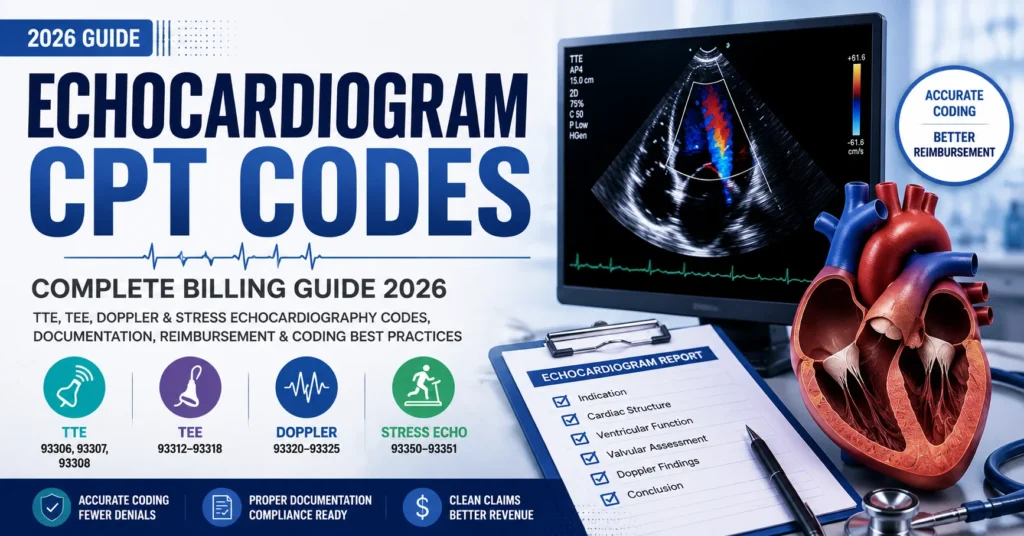

Choosing the right echocardiogram CPT code can become confusing because one code does not cover every type of echocardiography. Using a complete code for a limited study, separating bundled Doppler services, or selecting the wrong TEE code can lead to denials and payment delays. This guide explains the major echo CPT codes, their differences, documentation requirements, and billing rules for 2026.
What Is the CPT Code for an Echocardiogram?
CPT code 93306 is commonly used for a complete transthoracic echocardiogram (TTE) that includes spectral Doppler and color flow Doppler. However, the correct CPT code for an echocardiogram depends on the type of study, its scope, the components performed, and the supporting documentation.
For example, a limited follow-up TTE generally falls under 93308, while a complete diagnostic transesophageal echocardiogram (TEE) may fall under 93312.
Therefore, coders should identify exactly what the provider performed before selecting an echo CPT code.
Echocardiogram CPT Codes at a Glance
The following table provides a quick reference for commonly used echocardiogram CPT codes.
| CPT Code | Service | Common Application |
|---|---|---|
| 93303 | Complete congenital TTE | Comprehensive congenital cardiac evaluation |
| 93304 | Limited congenital TTE | Limited or follow-up congenital study |
| 93306 | Complete TTE with Doppler | Comprehensive standard echocardiogram |
| 93307 | Complete TTE without Doppler | Complete TTE without spectral/color Doppler |
| 93308 | Limited/follow-up TTE | Focused or follow-up cardiac evaluation |
| 93312 | Complete diagnostic TEE | Complete transesophageal echocardiogram |
| 93313 | TEE probe placement | Probe placement component |
| 93314 | TEE imaging and interpretation | Image acquisition, interpretation and report component |
| 93318 | Intraoperative TEE | TEE monitoring during surgery |
| 93320 | Complete spectral Doppler | Doppler add-on when separately appropriate |
| 93321 | Limited spectral Doppler | Limited Doppler add-on when appropriate |
| 93325 | Color flow Doppler | Color flow add-on when appropriate |
| 93350 | Stress echocardiography | Echo imaging during cardiovascular stress testing |
| 93351 | Stress echo with monitoring | Stress echo with applicable ECG monitoring elements |
| 93356 | Myocardial strain imaging | Myocardial deformation/strain assessment |
Within its Transthoracic Echocardiography coverage guidance, CMS identifies CPT codes 93306, 93307, and 93308 and explains that providers should report the appropriate limited or follow-up code when the documented examination does not support a complete study.
How to Choose the Correct Echocardiogram CPT Code
Start by identifying the type of echocardiogram actually performed. A transthoracic echocardiogram, transesophageal echocardiogram, and stress echocardiogram require different coding approaches.
Next, determine whether the study was complete or limited. A comprehensive examination should not be coded the same way as a focused follow-up examination.
Finally, review whether spectral Doppler, color flow Doppler, strain imaging, or other components were performed. The documentation must support the service reported.
A simple rule can help: code the service that was actually performed and documented, not simply the test that was ordered.
Transthoracic Echocardiogram CPT Codes
Transthoracic echocardiography (TTE) is a widely used form of cardiac ultrasound. According to the CMS Transthoracic Echocardiography coverage guidance, TTE uses ultrasound imaging to provide important information about the heart’s structure and function.
Three codes are particularly important when coding standard TTE services.
CPT Code 93306: Complete Transthoracic Echocardiogram
CPT 93306 represents a comprehensive transthoracic echocardiogram that includes 2D imaging, M-mode when performed, spectral Doppler, and color flow Doppler.
Because these Doppler components are already incorporated into 93306, they should not automatically be reported separately.
According to the American Society of Echocardiography coding guidance, CPT 93306 represents a comprehensive transthoracic echocardiographic examination that includes Doppler and color flow imaging.
Documentation should support the comprehensive nature of the examination and its required components.
CPT Code 93307: Complete Echo Without Doppler
CPT 93307 applies to a complete transthoracic echocardiographic examination without the spectral and color flow Doppler components included in 93306.
Therefore, coders should not select 93306 simply because the provider documented a “complete echo.” They should verify whether the required Doppler services were also performed and documented.
CPT Code 93308: Limited or Follow-Up Echocardiogram
CPT 93308 is used for a limited or follow-up transthoracic echocardiographic examination.
A provider may perform a focused echocardiogram to monitor a specific cardiac condition instead of conducting a complete evaluation. The CMS Transthoracic Echocardiography coverage guidance notes that limited studies may be appropriate for situations such as follow-up evaluation of a pericardial effusion or serial assessment of ventricular function during certain treatments.
This distinction makes 93308 especially important when preventing upcoding and documentation-related denials.
CPT 93306 vs 93307 vs 93308
Understanding the difference between these three codes is essential for accurate transthoracic echocardiogram CPT code selection.
| Feature | 93306 | 93307 | 93308 |
| Complete study | Yes | Yes | No |
| 2D imaging | Yes | Yes | Yes |
| M-mode when performed | Yes | Yes | Yes |
| Spectral Doppler included | Yes | No | No |
| Color flow Doppler included | Yes | No | No |
| Typical scope | Comprehensive | Complete without Doppler | Limited/follow-up |
The main difference between 93306 and 93308 is the scope of the examination. CPT 93306 describes a comprehensive TTE with Doppler components, while 93308 describes a limited or follow-up examination.
The American Society of Echocardiography coding guidance highlights the important distinction between CPT 93306 and 93308, emphasizing that they represent different levels of echocardiography service and that the documentation should support the code reported.
Transesophageal Echocardiogram (TEE) CPT Codes
A transesophageal echocardiogram uses an ultrasound probe positioned in the esophagus to obtain detailed cardiac images. Consequently, TEE CPT code selection differs from standard transthoracic echocardiography.
CPT 93312: Complete Diagnostic TEE
CPT 93312 generally represents the complete diagnostic TEE service when the applicable components of the complete examination are performed.
The CMS Transesophageal Echocardiography billing and coding guidance addresses CPT codes 93312 through 93318 and outlines the applicable billing and documentation requirements for TEE services.
CPT 93313: TEE Probe Placement
CPT 93313 relates to placement of the transesophageal probe when the applicable service represents that component rather than the complete diagnostic procedure.
This distinction matters when different providers perform different parts of the TEE service.
CPT 93314: TEE Imaging and Interpretation
CPT 93314 addresses the applicable imaging acquisition, interpretation, and reporting component rather than the complete TEE procedure.
Coders should not split a complete service into individual components simply to generate additional charges. Instead, the reported code must reflect who performed each service and what the documentation supports.
Other TEE CPT Codes
The TEE family also includes codes for congenital studies and intraoperative services, including 93315 through 93318.
These services involve different circumstances, so coders should review the current code set and payer requirements before submitting the claim.
What is the CPT code for a TEE? For a complete diagnostic transesophageal echocardiogram, 93312 is a key code. However, 93313, 93314, and other TEE codes may apply when only specific components or different types of TEE services are performed.
Doppler and Advanced Echocardiography Codes
Doppler echocardiography evaluates blood flow and hemodynamic information that standard structural imaging alone may not provide.
Common related codes include:
- 93320 for complete spectral Doppler
- 93321 for limited spectral Doppler
- 93325 for color flow Doppler
- 93356 for myocardial strain imaging
However, bundling matters.
Does CPT 93306 Include Doppler?
Yes. CPT 93306 incorporates spectral Doppler and color flow Doppler as part of the comprehensive TTE service.
Centers for Medicare & Medicaid Services (CMS), specifically states that when Doppler is combined with a complete echocardiogram, 93306 is used.
Therefore, practices should not automatically add 93320 or 93325 to 93306. Always check current NCCI edits, code instructions, and payer-specific requirements before reporting additional services.
Stress Echocardiogram CPT Codes
Stress echocardiography combines cardiac ultrasound with exercise or pharmacologic stress to assess cardiac function under increased workload.
Two important codes are 93350 and 93351. The appropriate selection depends on the exact stress echocardiography service and associated monitoring performed.
Additional services may apply in specific circumstances. However, practices should verify bundling and payer rules rather than assuming that every component can be reported separately.
Stress echocardiography requires additional coding considerations because CPT 93350 and 93351 differ in the services and monitoring components they represent.
Echocardiogram Modifiers: 26 and TC
Professional and technical components can also affect echocardiogram billing.
Modifier 26 identifies the professional component when a provider performs the applicable interpretation and report but does not bill the technical portion.
In contrast, modifier TC identifies the technical component when applicable. This can include the equipment and technical resources involved in performing the test.
When one entity appropriately provides and bills the complete applicable service, global billing may apply instead.
Not every echocardiography code accepts component billing in the same way. Therefore, verify the code’s current modifier rules before submitting the claim.
Documentation Requirements for Echocardiogram Billing
Accurate documentation supports both code selection and medical necessity.
The medical record should clearly identify the type and scope of the examination. For a complete study, the report should support the comprehensive service billed. For a limited study, the documentation should show the focused reason and findings.
Depending on the service, documentation may include the clinical indication, structures evaluated, Doppler findings, measurements, interpretation, final report, and provider authentication.
CMS requires medical records to support the service reported. According to the CMS Transesophageal Echocardiography Billing and Coding guidance, documentation needed to establish medical necessity should be available when requested.
The same documentation-first principle applies across medical coding. For example, understanding documentation requirements is equally important when selecting between complete and limited renal ultrasound CPT codes or determining the correct level for an E/M service.
Medical Necessity and ICD-10-CM Coding
Selecting the correct echo CPT code does not automatically guarantee reimbursement.
The diagnosis and medical record must support why the echocardiogram was medically necessary. In addition, coverage can vary by Medicare Administrative Contractor and payer policy.
For example, the CMS Transthoracic Echocardiography coverage guidance distinguishes screening from medically necessary diagnostic echocardiography, indicating that routine screening may not meet Medicare coverage requirements when there is no supported diagnostic indication.
Therefore, practices should verify the applicable LCD, ICD-10-CM requirements, and payer policy instead of relying on the CPT code alone.
Common Echocardiogram Billing and Coding Errors
Even a correctly performed echocardiogram can result in a denial when coding and documentation do not align.
1. Billing 93306 for a Limited Study
Do not report a comprehensive code when the provider performed only a focused examination. A documented limited or follow-up TTE may support 93308 instead.
2. Separately Billing Doppler Already Included in 93306
CPT 93306 already incorporates spectral and color flow Doppler. Adding bundled Doppler services can create coding conflicts.
3. Incorrectly Unbundling TEE Components
Do not divide a complete TEE into separate component codes unless the actual circumstances and coding rules support component reporting.
4. Using the Wrong Modifier
Incorrect use of modifier 26 or TC can cause the claim to misrepresent which component the provider performed.
5. Incomplete Documentation
If a practice bills a comprehensive examination but the report supports only a limited service, the payer may question or deny the higher-level code.
6. Failing to Establish Medical Necessity
A technically correct CPT code still requires an appropriate clinical reason for the examination.
7. Ignoring Coding and Payer Edits
Check current NCCI edits and payer-specific billing rules before reporting related services together.
Strong claim review processes can catch many of these problems before submission. Practices facing recurring coding errors may also benefit from reviewing their broader medical billing and coding workflow instead of treating each denial as an isolated issue.
Practical Echocardiogram Coding Examples
Consider a few simple scenarios.
Example 1: Complete TTE with Doppler
A cardiologist performs and documents a comprehensive transthoracic study with the required spectral and color flow Doppler components. CPT 93306 may apply, subject to the complete documentation and payer requirements.
Example 2: Focused follow-up TTE
A patient returns for focused evaluation of a known pericardial effusion. The provider performs only the medically necessary limited examination. CPT 93308 may be appropriate when the documentation supports that service.
Example 3: Complete diagnostic TEE
A provider performs the applicable components of a complete diagnostic transesophageal examination. CPT 93312 may apply rather than separately reporting component services.
Actual code selection should always reflect the medical record, current CPT guidance, NCCI edits, and payer policy.
Final Thoughts
There is no single echocardiogram CPT code for every cardiac ultrasound. CPT 93306 commonly applies to a complete TTE with Doppler, while 93308 addresses limited or follow-up TTE services and 93312 is important for complete diagnostic TEE services.
Accurate billing starts with the medical record. Match the code to the service actually performed, confirm included components, document medical necessity, and check current payer and NCCI requirements before submitting the claim.
Last reviewed: August 18, 2026
Coding and coverage requirements can change and may vary by payer and jurisdiction. Verify current CPT guidance and applicable payer policies before billing.
Frequently Asked Questions About Echocardiogram CPT Codes
What is the most common CPT code for an echocardiogram?
93306 is a commonly used CPT code for a complete transthoracic echocardiogram with spectral and color flow Doppler. However, it is not the correct code for every echo. The type and extent of the examination determine code selection.
What is CPT code 93306 used for?
CPT 93306 is used for a comprehensive transthoracic echocardiographic examination that includes the applicable 2D imaging, M-mode when performed, spectral Doppler, and color flow Doppler components.
What is the CPT code for a limited echocardiogram?
CPT 93308 is commonly used for a limited or follow-up transthoracic echocardiogram. The documentation should show that the examination focused on a specific problem or follow-up need rather than a complete cardiac assessment.
What is the difference between CPT 93306 and 93308?
CPT 93306 represents a comprehensive TTE with spectral and color flow Doppler. CPT 93308 represents a limited or follow-up TTE and does not include those Doppler components within the base service.
What is the CPT code for a transesophageal echocardiogram?
CPT 93312 is a key code for a complete diagnostic TEE. However, other codes such as 93313 and 93314 may apply when only specific components are performed.
Can CPT 93320 and 93325 be billed with 93306?
Do not automatically report them together. CPT 93306 already incorporates spectral Doppler and color flow Doppler. Review current coding edits and payer rules before reporting related services separately.
Does the correct echocardiogram CPT code guarantee Medicare payment?
No. Correct CPT coding alone does not guarantee coverage or payment. The service must also meet applicable medical necessity, documentation, diagnosis, and Medicare coverage requirements.