

TL;DR
- The BPH ICD 10 code is N40.0 for benign prostatic hyperplasia without lower urinary tract symptoms and N40.1 for BPH with symptoms. Both codes are billable. The parent code N40 is not.
- “Benign prostatic hypertrophy,” “benign prostatic hyperplasia,” and “enlarged prostate” all belong to the N40 family.
- There is no “BPH unspecified” code. N40.9 does not exist. Enlarged prostate NOS codes to N40.0.
- The ICD-10 code for history of BPH is Z87.438, not Z87.44.
- When you report N40.1, add the documented symptom codes such as R35.0, R35.1, R39.11, R39.12, or R33.8.
Picking the right BPH ICD 10 code looks simple until a claim comes back denied. Coders report N40 as a billable code, choose N40.1 without symptom documentation, or borrow a “history of” code that belongs to the urinary system. Each mistake costs time and revenue.
This guide fixes that. You will learn every valid N40 code for FY2027, how to choose between N40.0 and N40.1, which symptom codes to add, and how to handle “unspecified” and “history of BPH” correctly.
What Is the ICD-10 Code for BPH? (Quick Answer)
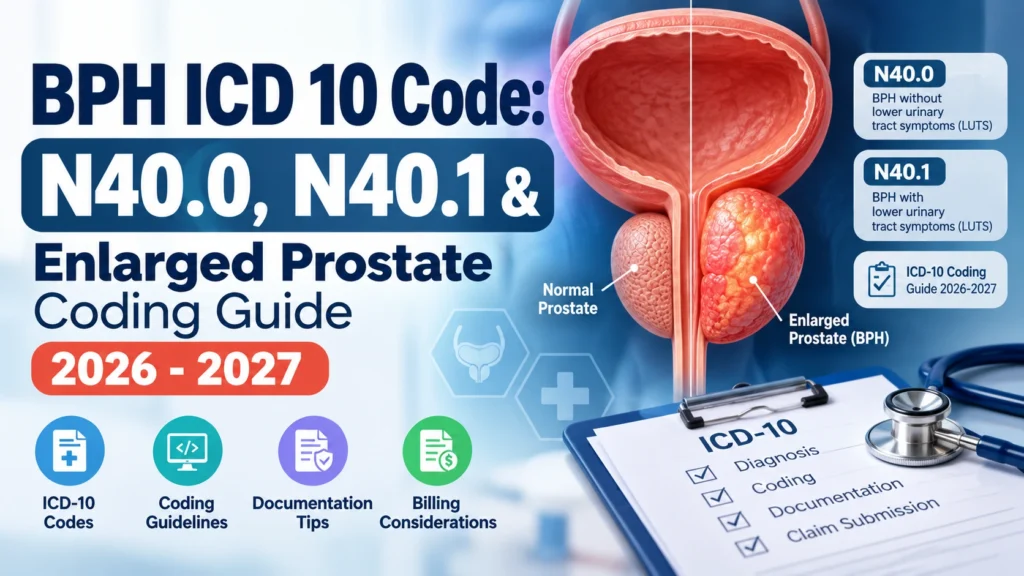
The ICD-10-CM code for benign prostatic hyperplasia is N40.0 when the provider documents no lower urinary tract symptoms and N40.1 when the provider documents lower urinary tract symptoms (LUTS). The Centers for Medicare & Medicaid Services publishes the full FY2027 code set, effective October 1, 2026 through September 30, 2027, on its ICD-10 codes page. The N40 category has not changed since FY2017.
| Code | Description | Billable | ICD-9 crosswalk |
|---|---|---|---|
| N40 | Benign prostatic hyperplasia (category header) | No | — |
| N40.0 | Benign prostatic hyperplasia without lower urinary tract symptoms | Yes | 600.00 |
| N40.1 | Benign prostatic hyperplasia with lower urinary tract symptoms | Yes | 600.01 |
| N40.2 | Nodular prostate without lower urinary tract symptoms | Yes | 600.20 |
| N40.3 | Nodular prostate with lower urinary tract symptoms | Yes | 600.21 |
Two edits apply to every code in this family. First, payers accept these codes for male patients only. Second, the age edit covers patients aged 15 through 124. A claim that violates either edit will reject before a human ever reviews it.
Benign Prostatic Hypertrophy vs. Hyperplasia vs. Enlarged Prostate: Same Code?
Yes. ICD-10-CM treats all three terms as the same diagnosis. The Includes note under N40 lists benign prostatic hypertrophy, benign hypertrophy of the prostate, enlarged prostate, nodular prostate, polyp of prostate, and adenofibromatous hypertrophy of the prostate.
Clinically, hyperplasia means an increase in the number of cells, while hypertrophy means an increase in cell size. Pathologists prefer “hyperplasia” because that is what happens in the prostate. For coding purposes, however, the distinction does not matter. Whether the provider writes “benign prostatic hypertrophy,” “BPH,” or “enlarged prostate,” you will land in N40.
N40.0 vs N40.1: How to Choose the Right BPH Code
Only one factor decides the code: did the provider document lower urinary tract symptoms? If yes, report N40.1. If no, report N40.0. Prostate size, PSA level, and medication use do not change the code selection.
What counts as lower urinary tract symptoms
The American Urological Association groups LUTS into storage and voiding symptoms in its BPH guideline. Storage symptoms include urinary frequency, urgency, nocturia, and incontinence. Voiding symptoms include hesitancy, weak stream, straining, intermittency, incomplete emptying, and retention.
Documentation that supports N40.1
Look for a named symptom, an IPSS or AUA Symptom Index score, a post-void residual measurement, uroflowmetry results, or a digital rectal exam with estimated prostate volume. Any one documented symptom justifies N40.1. A symptom score alone, without the symptoms named, is weaker but usually acceptable.
When the note says nothing about symptoms
Default to N40.0, or send a query. A simple query works well: “The note documents BPH. Please clarify whether the patient has associated lower urinary tract symptoms such as frequency, nocturia, or weak stream, and document any present.” Do not assume symptoms because the patient takes tamsulosin.
“Use Additional Code”: Symptom Codes to Report With N40.1
N40.1 carries an instructional note: use additional code for associated symptoms, when specified. In other words, N40.1 alone does not describe the whole picture. Add each documented symptom from the table below.
| Documented symptom | ICD-10-CM code |
|---|---|
| Urinary frequency | R35.0 |
| Nocturia | R35.1 |
| Urinary hesitancy | R39.11 |
| Weak urinary stream | R39.12 |
| Feeling of incomplete bladder emptying | R39.14 |
| Urinary urgency | R39.15 |
| Straining to void | R39.16 |
| Urinary retention | R33.8 |
| Urinary obstruction | N13.8 |
| Urinary incontinence | N39.4- |
Sequencing examples
- BPH with nocturia: N40.1, R35.1
- BPH with urinary retention: N40.1, R33.8. R33.8 carries a “code first” note that points back to N40.1, so BPH stays in the first position.
- BPH with urinary obstruction: N40.1, N13.8. The same code-first logic applies.
Notice the pattern. The disease leads, and the symptom follows. Reversing that order triggers edits on many payer systems.
Is There an ICD-10 Code for BPH “Unspecified”?
No. ICD-10-CM contains no N40.9, and any claim that uses it will reject. The Alphabetic Index sends “Enlarged prostate NOS” directly to N40.0, so BPH documented without symptom detail codes to N40.0.
Some coders reach for N42.9, disorder of prostate, unspecified. That is a different condition. N42.9 covers prostate problems the provider has not identified, not a diagnosed enlargement. Using it for BPH understates the diagnosis and can fail medical-necessity checks for BPH medications and procedures.
You can verify both points in the CDC ICD-10-CM browser, which lists every valid N40 code and index entry at no cost.
History of BPH ICD 10 Code
The ICD-10 code for history of BPH is Z87.438, personal history of other diseases of male genital organs. Many online guides list Z87.44 instead. That code is wrong for this purpose because Z87.44 covers personal history of diseases of the urinary system, such as prior urinary tract infections or kidney stones. The prostate is a male genital organ, so Z87.43- is the correct subcategory.
When “history of” applies
Use Z87.438 only when the BPH has resolved, usually after TURP, HoLEP, or simple prostatectomy, and the provider documents no residual disease or symptoms. Pair it with the status code the documentation supports, such as Z90.79 for acquired absence of other genital organs or Z98.890 for other specified postprocedural states.
When “history of” does not apply
BPH is a chronic condition. A patient on finasteride or tamsulosin still has BPH, so report N40.0 or N40.1, not a history code. The same rule applies after a minimally invasive procedure if any prostate tissue remains and symptoms persist.
One more distinction matters. Z87.430 covers personal history of prostatic dysplasia, a precancerous finding. Do not confuse it with resolved BPH.
Excludes1, Code-First, and Codes Often Confused With BPH
Category N40 carries an Excludes1 note for D29.1, benign neoplasm of prostate, and N42.1, congestion and hemorrhage of prostate. Report those conditions instead of N40, never alongside it. In practice, a biopsy-confirmed adenoma belongs in D29.1.
Several other codes cause confusion:
- C61, malignant neoplasm of prostate. Never assign cancer from an elevated PSA alone.
- R97.20, elevated prostate specific antigen. Use it with N40.x while cancer remains unconfirmed.
- N41.-, inflammatory diseases of prostate (prostatitis).
- N42.3-, dysplasia of prostate.
- Z80.42, family history of prostate cancer.
- Z12.5, encounter for screening for malignant neoplasm of prostate.
BPH Coding by Encounter Type and Procedure
For office visits and medication management, report N40.0 or N40.1 plus any symptom codes. Then select the evaluation and management level by medical decision making or time. New urology patients with multiple symptoms and prescription management often support a level four or five visit, which our 99203 CPT code guide and 99205 CPT code guide explain in detail.
For imaging, BPH with retention or elevated creatinine frequently leads to an upper-tract study. Our CPT code for renal ultrasound guide covers the 76770 versus 76775 decision.
For procedures, N40.1 is the usual supporting diagnosis for TURP (CPT 52601), prostatic urethral lift (52441 and 52442), water vapor thermal therapy (53854), and HoLEP (52649). Afterwards, code the postoperative status as described in the history section.
Two reimbursement notes help with planning. N40.x does not map to a payment category in the CMS-HCC V28 risk-adjustment model. On the inpatient side, N40 diagnoses group to MS-DRG 725 or 726, benign prostatic hypertrophy with or without major complication or comorbidity.
Real-World BPH Coding Scenarios
Scenario 1. A 68-year-old man has an enlarged prostate on digital rectal exam and reports no urinary complaints. Code N40.0. No symptoms, no symptom codes.
Scenario 2. A 72-year-old man reports nocturia three times nightly and a weak stream, with an IPSS of 18. Code N40.1, R35.1, R39.12. Each documented symptom gets its own code.
Scenario 3. A patient presents with acute urinary retention due to BPH, and the provider places a catheter. Code N40.1, R33.8. The code-first note keeps BPH in the primary position.
Scenario 4. A patient had a TURP in 2024, has no lower urinary tract symptoms, and the urologist documents no residual hyperplasia. Code Z87.438 plus the postprocedural status code the note supports.
Scenario 5. A patient has an elevated PSA and an enlarged prostate, and biopsy is pending. Code N40.0, R97.20. Do not report C61 until pathology confirms malignancy.
Common BPH ICD-10 Coding Errors and Denial Prevention
Run through this checklist before you release a BPH claim:
- Never bill the N40 header. Always pick N40.0 through N40.3.
- Confirm at least one documented symptom before you use N40.1.
- Add the symptom codes the note supports, in the order disease first, symptom second.
- Remember that N40.9 does not exist and N42.9 is not a BPH code.
- Use Z87.438 for resolved BPH, not Z87.44.
- Never code C61 from a PSA value alone.
- Check the male-only and age 15 to 124 edits.
- Query the provider when the note says only “mild BPH” without symptom detail.
Conclusion
Accurate BPH coding comes down to four habits. Choose N40.0 or N40.1 based on documented symptoms, add the symptom codes N40.1 asks for, skip the nonexistent “unspecified” option, and reserve Z87.438 for truly resolved cases. Follow those rules and your BPH claims will clear edits on the first pass under ICD-10-CM FY2027.
Related Guides and Resources
ICD-10 coding guides
- CVA ICD 10 Codes: Acute Stroke, History and Sequelae
- Abdominal Pain ICD 10 Codes: R10.9 and the Complete R10 Code Family
- Anemia ICD-10 Codes: A Complete Guide for Coders & Providers 2026–2027
- Right Hip Pain ICD 10 Code: M25.551 Explained
- Right Shoulder Pain ICD 10 Code: M25.511 Coding Guide 2026–2027
CPT and billing guides
- 99205 CPT Code: Description, Time, MDM and Billing Guide 2026–2027
- 99203 CPT Code: Complete Billing, Time & Reimbursement Guide 2026
- CPT Code for Renal Ultrasound: 76770 vs 76775 Guide 2026
- CBC CPT Code: 85025 vs. 85027 & Billing Guidelines 2026
- CPT Code 80061: Complete Lipid Panel Billing Guide 2026
Frequently Asked Questions
What is the ICD-10 code for BPH?
The ICD-10-CM code for BPH is N40.0 for benign prostatic hyperplasia without lower urinary tract symptoms and N40.1 for BPH with lower urinary tract symptoms. Nodular prostate uses N40.2 and N40.3.
What is the ICD-10 code for enlarged prostate?
Enlarged prostate uses the same N40 family. Report N40.0 without urinary symptoms and N40.1 with urinary symptoms. The Alphabetic Index sends enlarged prostate NOS to N40.0.
What is the ICD-10 code for BPH unspecified?
There is no unspecified BPH code. N40.9 does not exist. When documentation gives no symptom detail, report N40.0.
What is the difference between N40.0 and N40.1?
N40.0 means the provider documented no lower urinary tract symptoms. N40.1 means the provider documented at least one, such as frequency, nocturia, hesitancy, or weak stream.
What is the ICD-10 code for history of BPH?
Z87.438, personal history of other diseases of male genital organs. Use it only after BPH has resolved, typically after surgery. Active BPH on medication still codes to N40.0 or N40.1.
Is N40 a billable code?
No. N40 is a category header. Payers require a fourth character, so report N40.0, N40.1, N40.2, or N40.3.
What is the ICD-10 code for BPH with urinary retention?
Report N40.1 first, then R33.8 for other retention of urine. The R33.8 code-first note directs you to sequence the enlarged prostate first.
Is benign prostatic hypertrophy the same as hyperplasia in ICD-10?
Yes. ICD-10-CM lists benign prostatic hypertrophy as an inclusion term under N40, so both terms code identically.
What is the ICD-9 code for BPH?
ICD-9-CM used 600.00 and 600.01 for BPH without and with urinary obstruction, and 600.20 and 600.21 for nodular prostate. These map to N40.0 through N40.3.
Can N40.1 be the primary diagnosis?
Yes. N40.1 can be the first-listed diagnosis for office visits, imaging, and BPH procedures. Symptom codes such as R33.8 and N13.8 follow it.