
Abdominal pain looks easy to code, yet one vague note can send a claim toward R10.9 when a more specific option fits. That mistake can weaken clinical data, prompt payer questions and force staff to rework the claim. This guide solves the problem by mapping the current R10 family and explaining how documentation, care setting and date of service shape code selection.
TL;DR: Abdominal Pain ICD 10 Codes
- R10.9 is the billable ICD-10-CM code for unspecified abdominal pain when the record provides no specific location or pattern.
- R10 is a non-billable parent category and cannot support a claim by itself.
- Choose a more specific code when the record identifies a quadrant, abdominal region, pelvic location or flank.
- R10.84 describes generalized abdominal pain, while R10.85 describes abdominal pain of multiple sites.
- R10.0 represents acute abdomen, not every abdominal pain complaint that started recently.
- Chronic abdominal pain generally requires a site-specific R10 code. A G89 code may add chronicity when the record and coding guidelines support it.
- Always apply the code set that covers the date of service.
What Is the ICD-10 Code for Abdominal Pain?
The ICD-10-CM code for unspecified abdominal pain is R10.9. Use it when the provider documents abdominal pain but does not identify a more specific location, distribution or confirmed cause.
However, do not treat R10.9 as the automatic code for every abdominal pain encounter. When the record identifies a quadrant, region, flank, pelvic location or generalized pattern, choose the more specific R10 code that the documentation supports.
| Documentation | ICD-10-CM code |
|---|---|
| Unspecified abdominal pain | R10.9 |
| Acute abdomen | R10.0 |
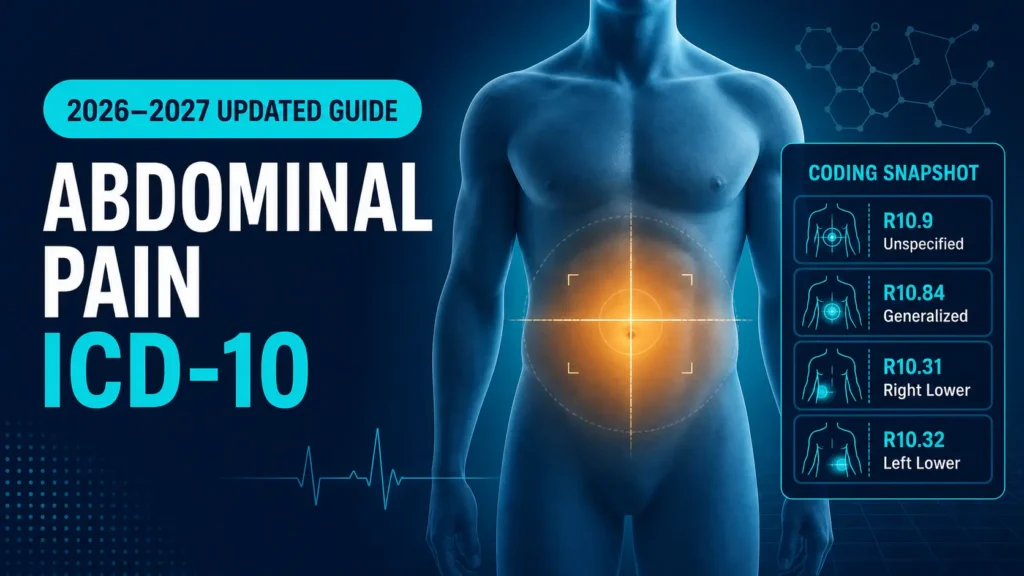
| Generalized abdominal pain | R10.84 |
| Abdominal pain of multiple sites | R10.85 |
| Right upper quadrant pain | R10.11 |
| Left upper quadrant pain | R10.12 |
| Right lower quadrant pain | R10.31 |
| Left lower quadrant pain | R10.32 |
Understanding the R10 Abdominal Pain Category
Category R10 covers abdominal and pelvic pain within Chapter 18 of ICD-10-CM. Chapter 18 contains symptoms, signs and abnormal findings for which the provider has not established another classifiable diagnosis.
The three-character code R10 acts as a category heading. It lacks the additional characters required for claim submission, so coders must select an appropriate billable child code.
The CDC’s National Center for Health Statistics maintains ICD-10-CM for diagnosis coding in the United States. Coders should first locate the documented term in the Alphabetic Index and then verify the selection, instructions and exclusions in the Tabular List.
Abdominal Pain ICD 10 Codes by Location
Location often provides the clearest route to a specific abdominal pain ICD 10 code. Therefore, providers should document the region, quadrant and laterality whenever the encounter supports that detail.
Upper Abdominal Pain Codes
| Code | Description |
| R10.10 | Upper abdominal pain, unspecified |
| R10.11 | Right upper quadrant pain |
| R10.12 | Left upper quadrant pain |
| R10.13 | Epigastric pain |
Use R10.10 when the provider identifies the upper abdomen but does not name a quadrant or the epigastric region. In contrast, R10.11, R10.12 and R10.13 capture more precise locations.
Pelvic, Perineal and Suprapubic Pain Codes
| Code | Description |
| R10.20 | Pelvic and perineal pain, unspecified side |
| R10.21 | Pelvic and perineal pain, right side |
| R10.22 | Pelvic and perineal pain, left side |
| R10.23 | Pelvic and perineal pain, bilateral |
| R10.24 | Suprapubic pain |
Do not confuse R10.21 and R10.22 with lower-quadrant pain. Those codes describe right- and left-sided pelvic and perineal pain. Right and left lower quadrant pain use R10.31 and R10.32.
Lower Abdominal Pain Codes
| Code | Description |
| R10.30 | Lower abdominal pain, unspecified |
| R10.31 | Right lower quadrant pain |
| R10.32 | Left lower quadrant pain |
| R10.33 | Periumbilical pain |
A note that states only “right-sided abdominal pain” does not identify one universal code. The provider should clarify whether the pain affects the upper quadrant, lower quadrant, pelvic region or flank.
Flank Pain Codes
| Code | Description |
| R10.A0 | Flank pain, unspecified side |
| R10.A1 | Flank pain, right side |
| R10.A2 | Flank pain, left side |
| R10.A3 | Flank pain, bilateral |
Flank pain can lead to diagnostic imaging, but the diagnosis code and procedure code serve different purposes. For related procedure guidance, review the CureMD Billers guide to renal ultrasound CPT codes.
R10.9 vs R10.84 vs R10.85
Coders often confuse unspecified, generalized and multiple-site abdominal pain. However, each term communicates a different level of information.
| Code | Meaning | Documentation |
| R10.9 | Unspecified abdominal pain | The record gives no specific location or distribution |
| R10.84 | Generalized abdominal pain | The provider describes pain as generalized or diffuse throughout the abdomen |
| R10.85 | Abdominal pain of multiple sites | The record identifies multiple abdominal sites under applicable guidance |
R10.9 reflects missing specificity. R10.84 reflects a known generalized distribution. Meanwhile, R10.85 describes multiple-site abdominal pain and does not represent abdominal rigidity.
Before assigning R10.85, review the Tabular instructions and Excludes1 notes. Those notes restrict its use with acute abdomen, generalized abdominal pain, abdominal rigidity NOS and localized abdominal pain codes.
Acute and Chronic Abdominal Pain ICD 10 Coding
Acute Abdominal Pain vs Acute Abdomen
R10.0 describes acute abdomen. It does not automatically apply whenever a patient says the pain began recently.
The provider’s diagnostic statement should support acute abdomen. Coders should not infer R10.0 solely from sudden onset, reported severity, guarding or another isolated finding. If the provider documents recent pain in a specific location without diagnosing acute abdomen, select the supported location code.
Likewise, severe abdominal pain does not have one universal code. The correct selection depends on whether the provider documents acute abdomen, generalized pain, a specific site or an unspecified presentation.
Chronic Abdominal Pain
ICD-10-CM does not provide one R10 code titled “chronic abdominal pain.” Instead, select the R10 code that captures the documented site or distribution.
A code from category G89 may add information about chronic pain when the documentation and encounter support it. For example, G89.29 describes other chronic pain. However, use G89.4 only when the provider documents chronic pain syndrome.
Sequencing depends on the encounter. When pain management drives the visit, the G89 code may come first. When the encounter addresses another purpose and no definitive diagnosis exists, the site-specific pain code generally comes first, followed by the supported G89 code.
Ongoing care may also involve separate E/M considerations. The CureMD Billers G2211 billing guide explains that add-on code’s longitudinal-care requirements.
Pain, Tenderness and Rebound Tenderness
Pain, tenderness and rebound tenderness represent different concepts. The patient usually reports pain, while the provider elicits tenderness during an examination.
R10.811 through R10.819 identify abdominal tenderness by location. Similarly, R10.821 through R10.829 identify rebound abdominal tenderness.
Code the findings that the provider documents and the applicable guidance allows. Do not replace a pain code with a tenderness code simply because the note mentions an abdominal examination.
How to Select the Correct Abdominal Pain Code
First, look for a definitive diagnosis that explains the pain. If the provider confirms appendicitis, cholecystitis, diverticulitis or another condition, determine whether the definitive diagnosis should replace the symptom code.
Next, identify the documented location and laterality. Review the history, assessment and other permitted documentation for a quadrant, abdominal region, pelvic location or flank.
Then determine the pattern. Distinguish unspecified pain from generalized pain, multiple sites, colic, chronic pain and acute abdomen.
Also separate reported symptoms from examination findings. Pain, tenderness, rebound tenderness, guarding and rigidity do not mean the same thing.
The care setting also matters. Under the ICD-10-CM Official Guidelines, outpatient coders do not code probable, suspected, rule-out or working diagnoses as confirmed. Instead, they report the symptom or other reason for the visit to the highest supported certainty.
For example, abdominal pain may support the diagnosis portion of an office claim, but it does not determine the E/M level. The CureMD Billers guide to CPT code 99213 explains how low medical decision-making or qualifying time determines that established-patient service.
Finally, verify the active code set and applicable payer requirements. A valid ICD-10-CM code does not guarantee coverage. Practices should review the relevant payer policy or the Medicare Coverage Database when Medicare requirements apply.
Documentation Checklist
Before selecting an abdominal pain code, confirm that the record addresses:
- Location and laterality
- Onset and duration
- Generalized versus distinct sites
- Acute or chronic status
- Pain quality and radiation
- Tenderness, rebound, guarding or rigidity
- Associated symptoms
- Confirmed or unconfirmed cause
- Reason for the encounter
Abdominal Pain Coding Examples
Example 1: Unspecified Abdominal Pain
The note states, “Patient reports abdominal pain but cannot identify the location.”
Consider R10.9 because the record does not support a more specific location or distribution.
Example 2: Right Lower Quadrant Pain
The provider documents, “Pain localized to the right lower quadrant; workup remains pending.”
Consider R10.31 because the record identifies a specific quadrant without confirming an underlying diagnosis.
Example 3: Generalized Abdominal Pain
The provider documents diffuse pain throughout the abdomen.
Consider R10.84 because the record identifies a generalized distribution rather than an unspecified location.
Example 4: Chronic Epigastric Pain
The provider documents chronic epigastric pain without a confirmed cause.
Consider R10.13 for the site. Then review whether a G89 code adds supported chronic-pain information under the circumstances of the encounter.
FY 2026 and FY 2027 Updates
The current FY 2026 code set applies through September 30, 2026. Important R10 additions include pelvic and perineal child codes R10.20 through R10.24, multiple-site pain code R10.85, flank tenderness codes R10.8A- and flank pain codes R10.A0 through R10.A3.
R10.2 still appears as the pelvic and perineal pain parent category, but it no longer provides a complete billable code. Coders must select an appropriate child code.
The FY 2027 code set applies to services from October 1, 2026 through September 30, 2027. The FY 2027 Official Guidelines define “multiple” as two or more sites. They direct coders to assign individual site codes when the record identifies the sites, absent chapter-specific guidance, and to use the appropriate multiple-sites code when the record does not identify them.
Always review the Tabular instructions because classification instructions take precedence. The CMS ICD-10 files identify the release that applies to each date-of-service range.
Common Abdominal Pain Coding Mistakes
Avoid these common errors:
- Submitting R10 as a complete code
- Choosing R10.9 despite a documented location
- Confusing unspecified pain with generalized pain
- Confusing pelvic codes with lower-quadrant codes
- Treating every new pain complaint as acute abdomen
- Describing R10.85 as abdominal rigidity
- Adding G89.4 without documented chronic pain syndrome
- Coding an outpatient suspected diagnosis as confirmed
- Applying a code set to the wrong date of service
- Assuming a valid code guarantees reimbursement
Final Takeaway
R10.9 provides the ICD-10-CM code for unspecified abdominal pain, but it should not replace supported specificity. Review the documented location, distribution, examination findings, confirmed diagnosis, care setting and date of service before selecting the final code.
This guide provides general education rather than individualized coding or billing advice. Verify each assignment against the current official files, complete record and applicable payer requirements.
Related Guides & Resources
The resources below cover related diagnostic services, medical coding and outpatient billing topics connected with abdominal pain encounters:
- Renal ultrasound CPT codes – CPT Code for Renal Ultrasound: 76770 vs 76775 Guide 2026
- Established-patient E/M coding – 99213 CPT Code: Complete Billing & Reimbursement Guide 2026
- New-patient office visit coding – 99203 CPT Code: Billing, Time & Reimbursement 2026
- Level-four new-patient visits – 99204 CPT Code: Essential Billing & Reimbursement Guide 2026
- Longitudinal care add-on coding – G2211 CPT Code: Billing Guidelines & Reimbursement 2026
- Medical billing resources – Explore CureMD Billers’ Medical Billing Guides
Frequently Asked Questions
What is the ICD-10 code for unspecified abdominal pain?
R10.9 identifies unspecified abdominal pain. Use it when the record provides no more specific location or distribution.
Is R10.9 billable?
Yes. R10.9 provides a complete billable ICD-10-CM code when the documentation supports unspecified abdominal pain.
What is the difference between R10.9 and R10.84?
R10.9 means the record does not specify the location or distribution. R10.84 means the provider documents generalized or diffuse abdominal pain.
What is the ICD-10 code for acute abdominal pain?
R10.0 represents acute abdomen. However, do not use it automatically for every recent-onset pain complaint. Choose the documented location code when acute abdomen lacks provider support.
How do you code chronic abdominal pain?
Choose the R10 code that identifies the documented site or distribution. Add an applicable G89 code only when it supplies supported chronic-pain information.
What is the code for right-sided abdominal pain?
The correct code depends on the location. Right upper quadrant pain uses R10.11, right lower quadrant pain uses R10.31 and right flank pain uses R10.A1.
Can R10.9 serve as the first-listed diagnosis?
R10.9 may serve as the first-listed outpatient diagnosis when unspecified abdominal pain chiefly drives the encounter and the provider has not established a more definitive diagnosis.