
Coding a urinary tract infection may appear simple, but automatically assigning N39.0 can create an inaccurate claim. The documented infection site, current status, organism, pregnancy and catheter association can all change code selection. Without these details, practices risk coding errors and payer questions. This guide explains UTI ICD 10 coding for active, acute, recurrent, chronic and historical infections.
TLDR: UTI ICD 10 Coding at a Glance
- N39.0 represents urinary tract infection, site not specified.
- Use N39.0 when the provider documents an active UTI without identifying the anatomical site.
- Use a site-specific code when the provider documents cystitis, pyelonephritis or urethritis.
- Z87.440 represents a personal history of urinary tract infections when the infection has resolved.
- Recurrent and chronic UTI do not have one universal diagnosis code.
- Pregnancy, catheter association and postprocedural infection may require different coding pathways.
- Do not diagnose a UTI solely from symptoms, urinalysis or culture results.
- Always verify the code in the current ICD-10-CM Tabular List.
What Is the ICD-10 Code for a UTI?
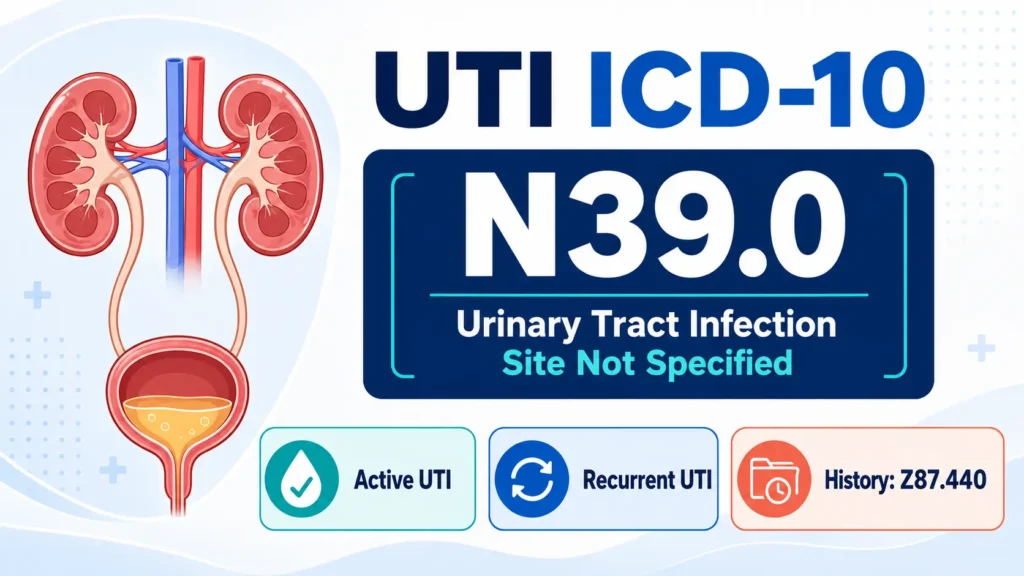
The ICD-10-CM code for a documented urinary tract infection when the site is not specified is N39.0. Use this code when the provider confirms an active UTI but does not identify the bladder, kidney, urethra or another specific part of the urinary tract.
The official description of N39.0 is:
Urinary tract infection, site not specified
N39.0 is a diagnosis code, not a CPT procedure code. It identifies the condition that the provider diagnosed, but it does not describe an office visit, urinalysis, urine culture or treatment.
The CDC’s National Center for Health Statistics maintains ICD-10-CM for diagnosis coding in the United States. It advises users to select the fiscal year that matches the date of service and review both the Alphabetic Index and Tabular List.
UTI ICD 10 Codes at a Glance
The following table summarizes common codes related to urinary infections. It does not replace the complete medical record or current ICD-10-CM instructions.
| Documented condition | Code | Coding consideration |
|---|---|---|
| UTI, site not specified | N39.0 | Active infection without a documented site |
| Acute cystitis without hematuria | N30.00 | Acute bladder infection without documented hematuria |
| Acute cystitis with hematuria | N30.01 | Acute cystitis with hematuria |
| Other chronic cystitis without hematuria | N30.20 | Chronic cystitis without hematuria |
| Other chronic cystitis with hematuria | N30.21 | Chronic cystitis with hematuria |
| Cystitis, unspecified without hematuria | N30.90 | Cystitis without a specified type |
| Cystitis, unspecified with hematuria | N30.91 | Unspecified cystitis with hematuria |
| Acute pyelonephritis | N10 | Acute kidney infection |
| Urethritis | N34.- | Select the supported child code |
| Asymptomatic bacteriuria | R82.71 | Not automatically equivalent to UTI |
| Personal history of UTI | Z87.440 | Previous urinary infection has resolved |
A three-character category such as N30 or N34 may not provide a complete billable code. Select the most specific child code supported by the documentation.
When Should You Use N39.0?
Use N39.0 when the provider documents a current urinary tract infection but does not identify its anatomical site. Terms such as “UTI,” “urinary infection” or “UTI, site unspecified” may support this code when no more specific diagnosis appears in the record.
N39.0 is not inherently an incorrect or inferior code. It accurately reports a UTI when the documentation does not establish a specific site. However, coders should not use it when the provider documents greater specificity.
Before assigning N39.0, confirm that:
- The provider documented an active UTI.
- The record does not identify the infection site.
- No special circumstance requires a different coding pathway.
- The current Tabular List supports the assignment.
- The care setting permits reporting the diagnosis as confirmed.
When Should You Not Use N39.0?
Do not use N39.0 automatically when the provider documents cystitis, pyelonephritis, urethritis or another site-specific condition. Those diagnoses identify the affected part of the urinary system and may require a different code.
N39.0 alone may also be insufficient for a UTI associated with pregnancy, a urinary catheter or a procedure. Likewise, it does not represent a resolved personal history of infection.
Symptoms and test results do not always establish a UTI diagnosis. Dysuria, frequency, leukocytes, pyuria or a positive culture should not lead a coder to assign N39.0 unless the provider documents the condition.
N39.0 vs Cystitis, Pyelonephritis and Urethritis
N39.0 vs N30.- Cystitis
N39.0 does not identify where the infection occurs. In contrast, cystitis identifies inflammation or infection involving the bladder.
When the provider documents acute cystitis, review N30.00 or N30.01 based on the presence of hematuria. Chronic and unspecified cystitis follow separate N30.- pathways.
Do not translate a generic UTI into cystitis based solely on urinary frequency, pelvic discomfort or a positive urine test.
N39.0 vs N10 Pyelonephritis
N10 may apply when the provider documents acute pyelonephritis. This condition identifies an acute infection involving the kidney rather than an unspecified urinary site.
Fever, flank pain, nausea or abnormal laboratory findings may support the clinical assessment. However, a coder should not independently convert those findings into pyelonephritis.
Flank pain may also lead to diagnostic imaging. The CureMD Billers guide to renal ultrasound CPT codes explains the difference between complete and limited renal examinations.
N39.0 vs N34.- Urethritis
Urethritis identifies inflammation or infection of the urethra. Select the appropriate N34.- child code when the provider documents that condition.
Burning during urination does not independently establish urethritis. If the provider documents only dysuria without a confirmed infection, a symptom code may be more appropriate.
How Do You Code Acute, Recurrent, Chronic and Historical UTIs?
Acute UTI ICD 10 Coding
There is no single code for every acute UTI. If the provider documents an active UTI without naming the site, N39.0 may apply.
When the documentation identifies acute cystitis or acute pyelonephritis, review the corresponding site-specific code. Coders should not infer the site from symptoms, urinalysis or culture findings.
Recurrent UTI ICD 10 Coding
Recurrent UTI describes infections that return over time, but it does not lead to one universal ICD-10-CM code. First determine whether the patient has a current infection.
For an active recurrent episode, code the current infection to the highest documented specificity. N39.0 may apply when the current infection is active but its site remains unspecified.
Do not automatically add Z87.440 to every active recurrent UTI. Report a history code only when the documentation, circumstances and reporting guidelines support it.
Chronic UTI ICD 10 Coding
“Chronic UTI” can describe different clinical situations. The provider may mean an active persistent infection, chronic cystitis, chronic pyelonephritis or a history of repeated infections.
Do not convert this informal wording into a specific chronic condition without supporting documentation. If clarification would change code selection, query the provider.
History of UTI ICD 10 Coding
The ICD-10-CM code for a personal history of urinary tract infections is Z87.440.
Use Z87.440 when a previous UTI no longer exists but the history affects current care, monitoring or decision-making. Do not use it as a replacement for a current infection.
How Do Organisms and Special Circumstances Affect Coding?
UTI With a Documented Organism
N39.0 identifies the infection but does not name its cause. The Tabular List instructs coders to use an additional code from B95 through B97 to identify an infectious agent when applicable.
For example, a documented E. coli UTI may require N39.0 plus the applicable organism code. Do not identify an organism from a preliminary result or make a diagnosis from the culture alone.
Use the free CDC ICD-10-CM Browser to check the applicable fiscal year, Index entries, complete code descriptions and instructional notes.
UTI During Pregnancy
An infection involving the urinary tract during pregnancy requires review of category O23. The correct code depends on the infection site, pregnancy stage and documentation.
Pregnancy-specific sequencing generally takes priority. Additional codes may identify the organism when the classification requires them.
Catheter-Associated or Postprocedural UTI
A documented catheter-associated UTI may require an applicable complication code from T83.51-, followed by additional coding for the infection or organism as instructed.
Do not assume a causal relationship simply because the patient has a catheter. The provider must connect the infection to the device.
Likewise, do not use N39.41 for a postprocedural UTI. N39.41 represents urge incontinence.
Neonatal UTI
P39.3 represents neonatal urinary tract infection. Review the perinatal guidelines and the newborn record before selecting this code instead of N39.0.
Can You Code a UTI From Symptoms or a Positive Culture?
A coder should not diagnose a UTI from symptoms, urinalysis or a urine culture. Clinical indicators can support the provider’s assessment, but they do not replace a documented diagnosis.
In an outpatient setting, do not code probable, suspected, questionable or rule-out conditions as confirmed. Instead, report the symptoms, signs, abnormal findings or reason for the visit to the highest supported certainty.
The FY 2026 ICD-10-CM Official Guidelines explain this outpatient uncertain-diagnosis rule. Inpatient uncertain-diagnosis rules differ, so the care setting matters.
For example, documented dysuria without a confirmed UTI may support R30.0. A positive culture without urinary symptoms may require review of asymptomatic bacteriuria or another provider-documented condition rather than N39.0.
How to Select the Correct UTI ICD 10 Code
Use this documentation-first process:
- Confirm that the provider documented a diagnosis.
- Determine whether the infection is active or resolved.
- Identify the documented anatomical site.
- Check whether the condition is acute, chronic or recurrent.
- Review cystitis documentation for hematuria.
- Identify any documented infectious organism.
- Check for pregnancy, catheter, procedure or neonatal circumstances.
- Locate the documented condition in the Alphabetic Index.
- Verify the code and instructions in the Tabular List.
- Apply any code-first, additional-code or sequencing requirements.
- Use the code set that applies to the date of service.
- Review relevant payer policies before claim submission.
This documentation-first approach also matters when coding symptoms. The CureMD Billers guide to abdominal pain ICD-10 codes explains how specificity and care setting affect symptom coding.
Practical UTI Coding Examples
Example 1: Active UTI Without a Specified Site
The provider documents “urinary tract infection” but does not identify the affected site.
Consider N39.0 because the record supports an active UTI without greater anatomical specificity.
Example 2: Acute Cystitis With Hematuria
The provider documents acute cystitis with hematuria.
Review N30.01 rather than N39.0 because the documentation identifies both the site and hematuria.
Example 3: Active UTI With Previous Episodes
The provider documents an active UTI without a specified site and notes several previous infections.
N39.0 may apply to the current infection. Review whether the resolved history affects current care before separately considering Z87.440.
Example 4: Previous UTIs Without Current Infection
The patient has no active infection, but previous UTIs affect monitoring and treatment decisions.
Z87.440 may apply because the condition represents a clinically relevant personal history rather than a current UTI.
Common UTI ICD 10 Coding Mistakes
Avoid these common errors:
- Assigning N39.0 to every urinary infection
- Treating N39.0 as a bladder-infection code
- Coding cystitis or pyelonephritis from symptoms
- Confusing an active infection with personal history
- Automatically combining N39.0 and Z87.440
- Treating recurrent and chronic UTI as interchangeable
- Missing hematuria specificity for cystitis
- Diagnosing a UTI from culture results
- Ignoring pregnancy or catheter-associated coding
- Interpreting “urosepsis” as sepsis without clarification
- Applying the wrong fiscal-year code set
FY 2026 and FY 2027 UTI Coding
FY 2026 ICD-10-CM applies through September 30, 2026. FY 2027 applies to services from October 1, 2026 through September 30, 2027.
Always select the release according to the date of service. At the time of this review, CMS listed FY 2027 code files but marked the FY 2027 ICD-10-CM guideline PDF as not yet available. Check the CMS ICD-10 files page before using this guide for claim submission.
Final Takeaway
N39.0 applies when the provider documents an active UTI without identifying its site. However, cystitis, pyelonephritis, recurrent infection, personal history, pregnancy and catheter association can change the coding pathway.
Review the complete record, care setting, date of service and current Tabular instructions before assigning the final code.
Related Guides and Resources
- Anemia ICD-10 Codes: Complete Guide 2026–2027
- Abdominal Pain ICD-10 Codes: Complete R10 Guide
- CPT Code for Renal Ultrasound: 76770 vs 76775
- 99213 CPT Code: Billing and Reimbursement Guide
- 99214 CPT Code: Essential Billing Guide
Frequently Asked Questions About UTI ICD 10 Codes
What is the ICD-10 code for a UTI?
N39.0 represents a urinary tract infection when the site is not specified. Use a more specific code when the provider identifies the affected site.
Is N39.0 used for an acute UTI?
N39.0 may apply when the provider documents an active or acute UTI without specifying its site. Documented acute cystitis or pyelonephritis may require another code.
What is the ICD-10 code for recurrent UTI?
There is no single code for every recurrent UTI. Code the current infection to its documented specificity. Z87.440 may apply when only a resolved personal history remains.
What is the ICD-10 code for a history of UTI?
Z87.440 represents a personal history of urinary tract infections. Use it when the previous infection has resolved and the history affects current care.
Is N39.0 the same as cystitis?
No. N39.0 does not identify the infection site. Cystitis identifies bladder involvement and follows the N30.- code family.
Can you code a UTI from a positive culture?
A coder should not independently diagnose a UTI from a culture result. The provider must document the diagnosis under the rules that apply to the care setting.
Is N39.0 billable?
N39.0 is a complete billable ICD-10-CM code when the documentation supports a site-unspecified UTI and the code remains valid for the applicable fiscal year.